
Para ice hockey takes over Pomeroy during High on Ice Winter Festival
People could try out para ice hockey at the Pomeroy Sports Centre on February 15th during the High on Ice Winter Festival in Fort St. John.
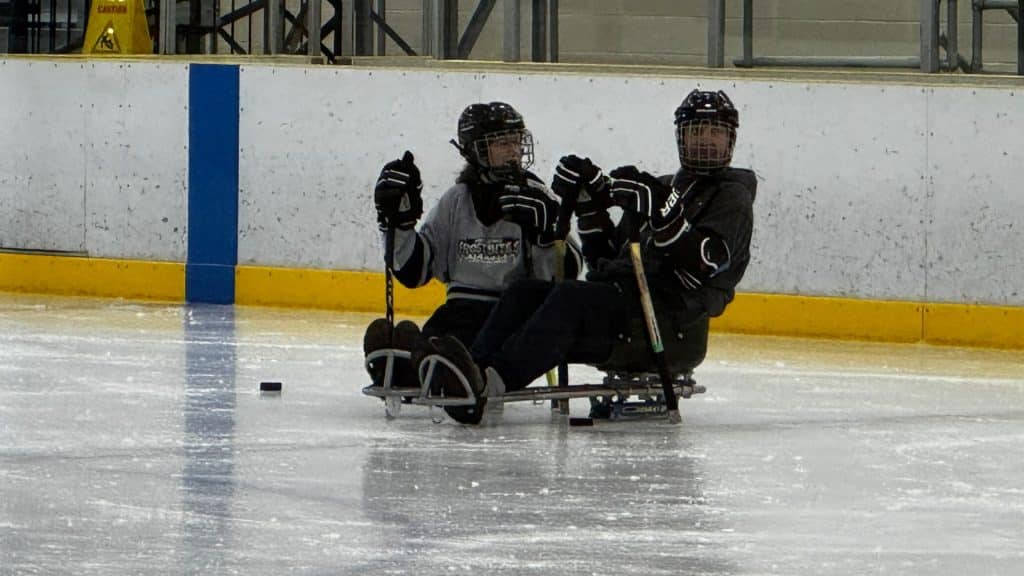
FORT ST. JOHN, B.C. — Hitting the ice with sleds instead of skates was on tap for those who ventured to the Pomeroy Sports Centre this weekend.
Those interested in the sport of para ice hockey got the chance to tackle the sport at a session on February 15th in Fort St. John during this weekend’s High on Ice Winter Festival.
Celebrating its 20th year, the festival took place from February 14th to 16th, 2025.
The event, facilitated by the City of Fort St. John and hosted by the Northern Adapted Sports Association (NASA), was held at the Pomeroy Sports Centre.
Formerly known internationally as sledge hockey, this sport involves players on sleds maneuvering around the ice. Its rules are similar to those of stand-up ice hockey, and players are required to hold two sticks rather than one.
The sport was first developed in Sweden in the 1960s, and three decades later, the first set of international rules was drafted from Canadian regulations.
The challenge, according to NASA coach Robert Stiles, is maintaining balance, as once you’re strapped into the sled you “become a skate”.
Latest Stories
Stiles added anything you see in stand-up hockey, including fights, is standard in a regular game.
“It’s completely full contact,” said Stiles. “If you have the blades really close, you can tip yourself [over] and you can move. You can stop yourself by cutting into the ice.”
“Usually, when you see players [fighting], it brings a shock. They will check each other too.”
The hour-and-a-half session was open to all participants. NASA provided equipment, including sticks, helmets, elbow pads and sleds.
Drills and scrimmages did become part of the action, with many players with a hockey background remarking on the differences.
It even brought out a Paralympian veteran: Robert “Bo” Hedges of Wonowon. Hedges has captained the Canadian wheelchair basketball team, most recently at the Paris Paralympics.
A veteran of five Paralympic games, Hedges led Team Canada to a gold medal in 2012 and a fourth-place showing in Paris in 2024.
“First time I’d been on the ice in 37 years,” said Hedges. “In around the team aspect and working together, and the motion. There’s a lot of similarities.”
Wilfred Newth also experienced his first para ice hockey session, with the Fort St. John resident describing his time on the ice as “awesome.”
“The one challenge was getting back up,” said Newth. “I’ve had surgically repaired shoulders from playing triple-a and junior hockey. But it was fun.”
Stiles told Energeticcity.ca that the session had about 13 participants.
Stay connected with local news
Make us your
home page
Authors

Related Articles

Fort St. John hockey player heading to play in new provincial junior league
Micah Pimm has signed with the British Columbia Hockey Conference’s Chilliwack Jets after graduating from the Notre Dame Hounds program in Saskatchewan
June’s Youth Athlete of the Month is willing to face new challenges in sport
Kenslee Hammond was nominated for her overall positive attitude and encouraging teammates to give their all.
Fort St. John bull rider named as finalist for Calgary Stampede
Jake Gardner has had several wins so far during the 2026 bull riding competition, and will be in the mix at July’s Calgary Stampede.