
17,500 files digitally repatriated to Dane-zaa people by Vancouver-based folklorist
The repatriated Ridington Dane-zaa archive contains over 11,000 audio files, almost 500 video files, 5,300 images and 700 textual files.
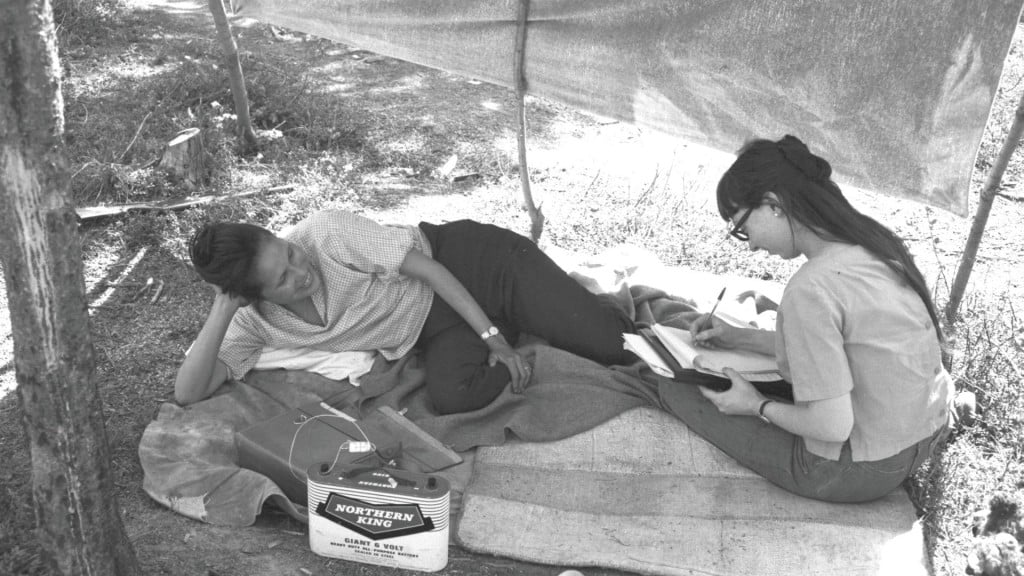
FORT ST. JOHN, B.C. — Documents, images and films pertaining to local Indigenous history recorded by anthropologists dating back to the 1960s have been repatriated back to Treaty 8 territory.
The Ridington Dane-zaa archive, a reserve of research materials, has been digitally returned to the Dane-zaa people, according to a news release.
It will be held in trust at the Treaty 8 Tribal Association in Fort St. John, where researchers can request to view it, with a permanent home to be announced in the future.
Local News Straight
to Your Phone
Download our app today!
Available on Android and iOS devices
Efforts to return the materials date back two decades, according to folklorist Amber Ridington.
Amber’s parents, Robin Ridington and Antonia Mills, travelled to northeast B.C. as graduate students from Harvard University back in 1964.
“[They] actually lived at Prophet River for about a year and a half between 1964 and 1966,” said Amber. “I was born in Fort St. John in 1969 at the end of a three-day tea dance.
“I spent most summers camping with communities while my parents did field work. Then, as an adult, I came to work with them.”
Latest Stories
According to a press release, Robin and his wife Jillian Ridington have been caretakers of the collections since the 1970s, but wanted to hand over stewardship of the collection to the communities.
Amber told Energeticcity.ca the collection includes over 11,000 audio files, almost 500 videos, 5,300 images and 700 textual files.
“The videos were started only around 1999 or 2000 and are of community events,” said Amber. “They are moose hunting camps and moose camps. Often there are oral histories that Elders would just want to share, and tea dances.”
In a statement in the release, Amber said: “Recently, funders of digitization projects have required that all materials be available to the public with no regard for Indigenous peoples’ rights to protect their materials and choose which, if any, of their heritage belongings are appropriate for unrestricted public access and circulation through the internet.”
The digital repatriation is being made possible through a $292,000 US (C$414,000) grant to the Treaty 8 Tribal Association from the Council on Library and Information Resources (CLIR).
CLIR is an organization based in Alexandria, Virginia which works with libraries, cultural institutions and higher learning communities on developing strategies to improve research, teaching and learning environments.
The three-year repatriation project will see a First Nation advisory group will hold sessions so that knowledge holders can identify appropriate protocols for their governance of the collection according to their cultural traditions of the Dane-zaa, Cree, Saulteau or settler associated with the items.
It will also support archival processing, development of a digital archive for safekeeping and transfer of ownership and custodianship as well as planning for physical repatriation of the original materials.
Elders and community members from around Treaty 8 communities have welcomed the return of the items, which include songs and stories from ancient times.
Doig River First Nation (DRFN) Elder, song and storykeeper Sam Acko said of Robin: “Because of Robin, there are so many songs, it’s not lost.
“Not only that, wonli nachii [mammoth] and ‘big animal’ [prehistoric creatures] days, those kinds of stories, he saved it all.”
DRFN member Garry Oker added: “[Robin] recorded a lot of stuff in the 60s and 70s when there were a lot of drummers and singers, and we still use those today.”
Amber said she is “incredibly grateful” for her relationship with the Treaty 8 communities, saying the announcement of the repatriation “makes it worthwhile.”
“I feel it’s worthwhile in that getting the materials and building the capacity of the community so they can have their own database systems and their own archives and manage the materials themselves,” said Amber.
“It is a piece of reconciliation work that needs to happen, and I feel good about doing that work.”
Stay connected with local news
Make us your
home page
Authors

Related Articles
Organizers of second Cultural Gathering of Nations seek sponsorship from Dawson Creek council
The organizers behind the Cultural Gathering of Nations at the Ovintiv Events Centre have sought sponsorship from the City of Dawson Creek.

Election for Saulteau First Nations chief and council draws near
An election to select a new council and chief for Saulteau First Nations in Moberly Lake will take place on Monday, March 30th.
Blueberry River First Nations chief and council urge members against ‘escalating situation’ with pipeline protest
Protesters and contractors from Blueberry River First Nations (BRFN) set up a road blockade north of Fort St. John on Monday, March 2nd to protest the NEBC Connector project, but BRFN chief and council do not condone the action.