
Black bear rescued after curling up on Dawson Creek road
The young black bear was rescued by a motorist in Dawson Creek on December 21st when windchill temperatures were around -35 C.
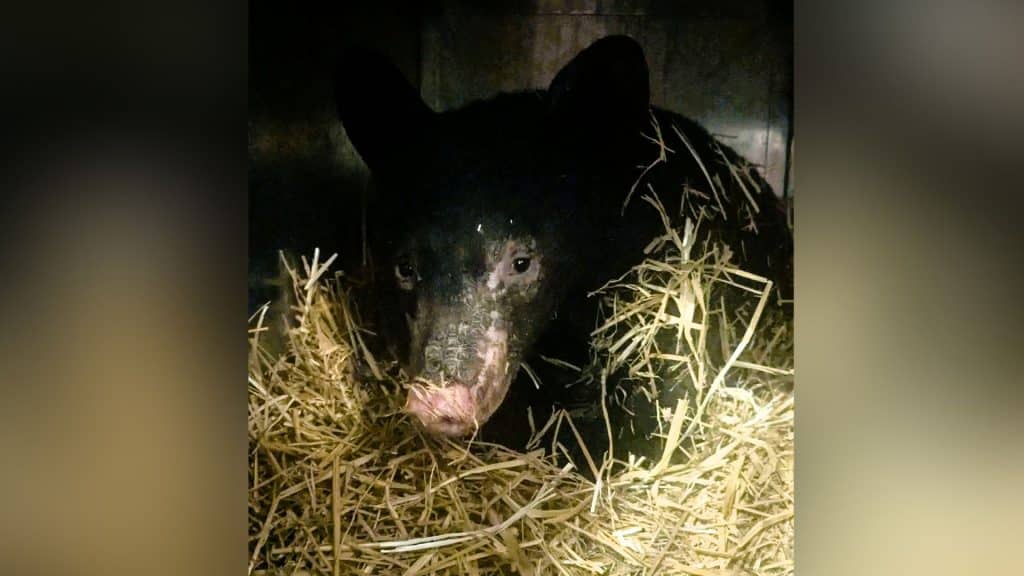
DAWSON CREEK, B.C. — A young bear cub is lucky to be alive after being rescued near Dawson Creek.
The young bear was discovered on Sunday, December 21st by a motorist off of 188 Road outside the city, says Northern Lights Wildlife Society (NLWS) manager Angelika Langen.
According to Langen, the NLWS is a shelter for injured and orphaned wildlife, servicing all the mammals of B.C., except those in the Lower Mainland and Vancouver Island.
“The gentleman saw the bear a couple of times on the road,” Langen told Energeticcity.ca. “He then saw it on Sunday night, sleeping in the middle of the road, all curled up.
“He shooed it off the road, underneath a tree. Then it curled up again. He could see it was in distress.”
With temperatures plummeting to -35 C with windchill early on Sunday, the motorist – identified by Langen as a man named Sean Jackson – contacted the NLWS.
After receiving government permission to recover the animal, Jackson and NLWS volunteer Renata Debolt returned to rescue the bear, placing it in a crate.
Latest Stories
It was taken to Debolt’s residence to allow it to warm up, with the footage being captured in a social media video.
The bear was then transported to NLWS, where it will be examined on Tuesday, December 23rd.
“Renata took him to her home for a slow warm up,” said Langen. “You have to do that very carefully. It’s very much like when a human is half frozen to death. You can’t just make them all warm and cozy right away.”
Langen says there is no news on the bear’s gender or what possible injuries the bear may have, suspecting facial trauma may be burns.
“It has injuries on its face at this point,” said Langen. “I really need to have a closer look at it. We thought at first that it was frostbite, but we’re not so sure right now.”
Langen says without the intervention of Jackson and the NLWS, the bear might have had a darker fate.
“It would not have lasted the night,” said Langen.
Langen added rescues such as this are a community effort.
“If the public is not observant and lets us know where help is needed, then we can’t assist,” said Langen. “It is a huge group of people that make this all happen, from the person that reports it to the government giving permission to volunteers to help capture and transport donors who make it possible to take care of them. It’s a community that makes rescues possible.”
More details about the NLWS and its services are available on its website and Facebook page.
Stay connected with local news
Make us your
home page
Authors

Related Articles

North Peace Museum offering Canada Day scavenger hunt and open house
The museum’s curator said the event on July 1st is an opportunity for residents to see the facility’s new temporary exhibit courtesy of the Charlie Lake Conservation Society.
City of Fort St. John hosting annual municipal report meeting
The City of Fort St. John will host it’s annual municipal report meeting on June 22nd at City Hall.