
Division of $426K Site C legacy funds question stalls regional board decision
As BC Hydro’s Site C hydroelectric dam project nears the end of its construction, the regional district has begun the process of dividing funds promised by the utility.
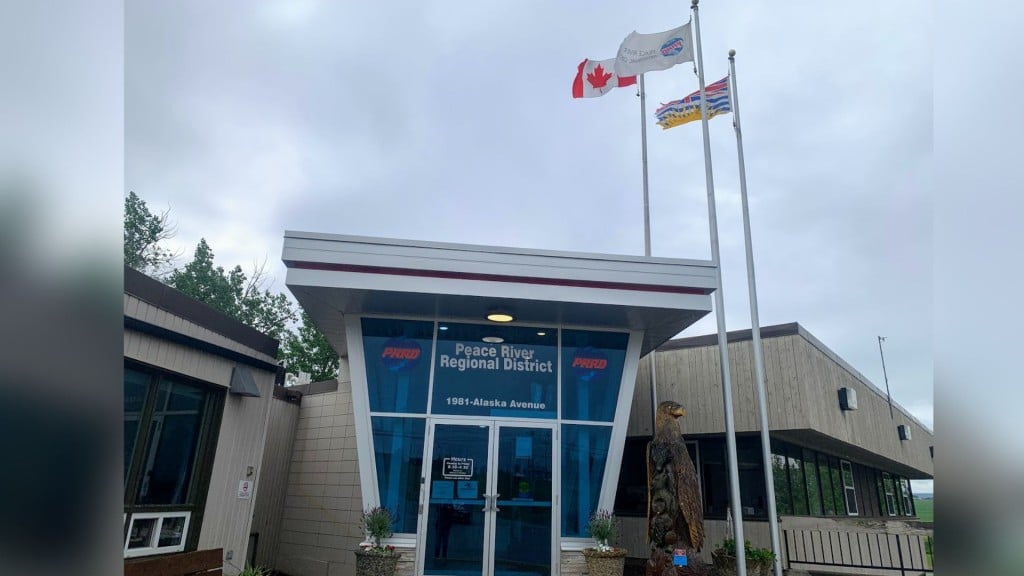
FORT ST. JOHN, B.C. – As BC Hydro’s Site C hydroelectric dam project nears the end of its construction, the regional district has begun the process of dividing funds promised by the utility.
In 2013, prior to the start of construction, the Peace River Regional District (PRRD) and member municipalities signed the Site C Regional Legacy Benefits Agreement, which promised 70 years of annual funding.
The funds, which will total $2.4 million, were approved to be distributed “beginning in the year that operations of Site C power generation begin”.
According to PRRD staff and BC Hydro, power generation began on October 28th 2024, and the utility is expected to provide payment based on 65 days of power generation, approximately $426,000.
During the January 23rd regional board meeting, the directors reviewed and approved adopting the Site C Regional Legacy Benefits Policy, which came with two limitations on the rural populations’ portion of the funding and details how the funding is distributed.
The limitations detailed that funding must be invested into PRRD-owned “Tangible Capital Assets”, and be fully used within a five-year cycle.
According to the language of the update, each municipality and the PRRD get a certain percentage of the legacy funds, calculated by population and service impact.
Latest Stories
Due to 2023 population statistics, the City of Fort St. John and the City of Dawson Creek can expect to receive the largest percentage of this funding at 37.10 per cent and 12.02 per cent respectively.
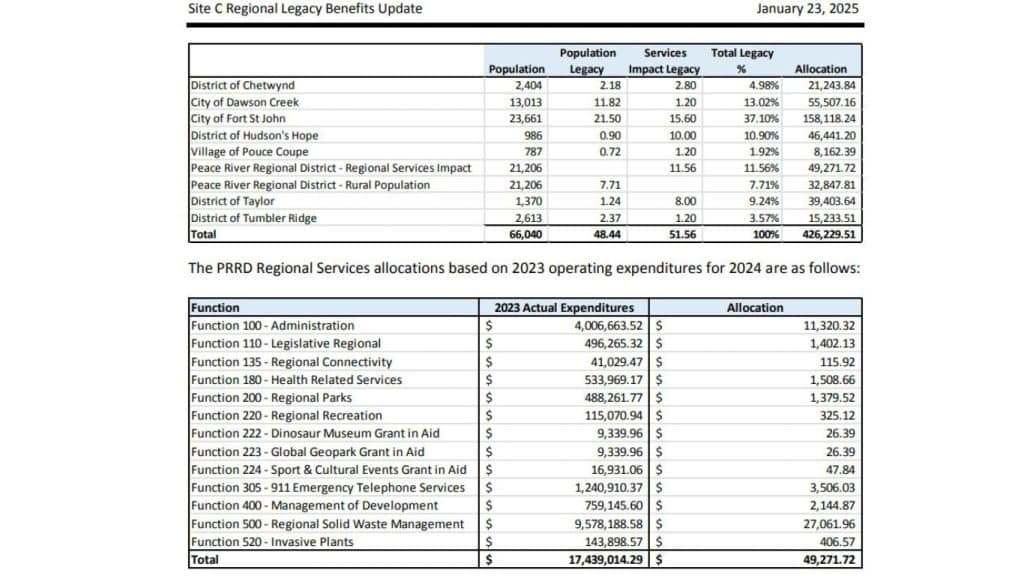
A portion of the funds, specified as the Regional Services Impact portion, was to be allocated according to region-wide service functions such as solid waste management, parks, recreation and administration.
Bradley Sperling, director for Electoral Area C, and Dan Rose, director for Electoral Area E, both raised concerns about the funding allocation, questioning what the four electoral areas get for impact funding.
“[The electoral areas] are forced to spend our money on the functions that everybody covers, so it’s a double dip for the municipalities,” Director Dan Rose of Electoral Area E said.
“[The agreement] is forcing us to spend the money on areas that are regionally funded, and [the municipalities] are already getting the lion’s share of this legacy agreement.”
Sperling expressed disagreement with the agreement’s funding allocation, asking if the allocation could be adjusted and recommending a decision on allocating the funding be deferred until an answer is available on whether the agreement can be adjusted.
“I’m not so much worried about the percentages and how it’s divided up, but what the four electoral area directors actually get. Because the way I look at it we’re getting virtually none,” Sperling said.
“It was drawn up by this board, the percentages were put out by this board, we should be able to revisit our own document.”
Shawn Dahlen, the chief administrative officer, confirmed staff could look into possible changes to the agreement, and bring it back before the board once that answer is found.
Following this confirmation, the directors unanimously voted in favor of deferring the motion until a legal opinion is obtained on whether the agreement can be revisited.
Stay connected with local news
Make us your
home page
Authors

Related Articles
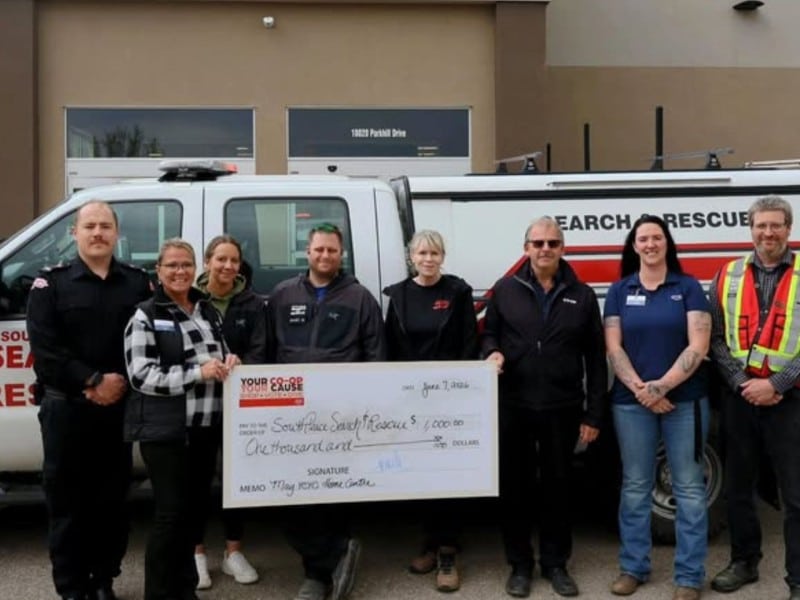
South Peace Search and Rescue named ‘Your Co-op, Your Cause’ recipient
The South Peace Search and Rescue has been gifted a $1,000 donation from the ‘Your Co-op, Your Cause’ initiative
Provincial and federal government commitment to forests to include Fort Nelson project
Total investments from the federal and provincial government toward reforestation and habitat restoration is $355 million.
Woman and dog die in Alaska Highway crash
Northern Rockies RCMP have reported a single vehicle car crash on the Alaska Highway ended with a woman and her dog dying on June 11th.