
HALL: Clarity would go a long way
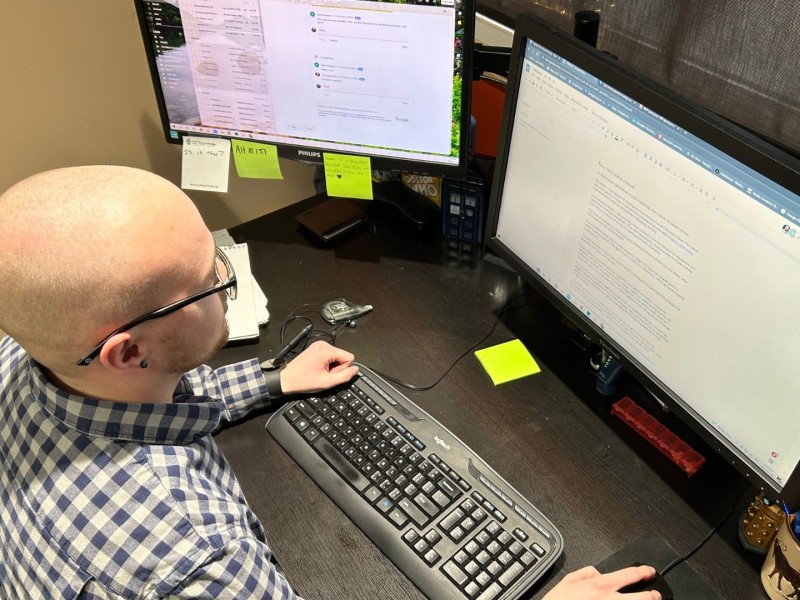
It’s challenging to get a sense of what’s happening when nobody will speak with you.
This month, I was tasked with figuring out where the province and Blueberry River First Nation and other nations in Treaty 8 were at in the consultation process after a historic court ruling ordered a halt to industrial development in Blueberry territory.
It’s a welcome change — and one that is much overdue — but the execution of negotiations and consultations has been problematic. They lack transparency, causing anxiety for those working in the resource industry at a time of increasing economic uncertainty.
This op-ed is a companion piece to the story referenced above to inform you, the reader, what the process was like writing this story.
Local News Straight
to Your Phone
Download our app today!
Available on Android and iOS devices
It’s also a call for further clarity in these situations. When information isn’t shared openly, it causes those who are left in the dark to jump to their own conclusions, which can have troubling consequences.
The claim was that our region had lost $2.5 billion in drilling activity due to permitting delays that arose after the Yahey court decision.
We anticipated it would take about two weeks for me to gather information, conduct the necessary interviews, and write up the story. Instead, I spent two weeks leaving a series of unanswered voicemails and emails. If I did get a response, it was often a written statement without the opportunity to ask questions — I haven’t seen this much red tape since Christmas.
The first thing on my list was to reach out to the ministry of Indigenous relations, who told me I needed to speak to someone from the ministry of energy. I put in my request only to be told that nobody would be available for an interview, and was given the following statement by the ministry of energy.
Latest Stories
“Oil and gas permitting in Northeastern BC has not stopped, though, and the Oil and Gas Commission has approved some authorizations for oil and gas activities in the northeast. More than 380 decisions have been made on permits in the northeast since January 2022.
The province continues critical work to provide clarity following the Yahey court decision, and negotiations continue between our government and other Treaty 8 Nations to improve land and resource stewardship. Negotiations are advancing, and we hope to have more to say on this topic soon.”
I had also hoped the ministry would have more to say, especially because they provided Rob Shaw, a columnist with The Northern Beat, a statement with an identical closing sentence in an article he wrote about the permitting delays in late September.
I asked some follow-up questions and waited about ten days only to be given a short statement answering none of them.
I reached out to leaders of First Nations in Treaty 8. After some persistence on my part, Blueberry declined to comment. Halfway River’s leadership was at the COP27 conference in Egypt and thus unavailable. The only leader I was able to speak to was Doig River Chief Trevor Makadahay.
I reached out to the BC Oil & Gas Commission, who declined to comment, instead directing me to the ministry of energy. The Fort St. John Petroleum Association ultimately passed me along to Tourmaline, whom I could not establish contact with. I was also unable to speak to anyone at Canadian Natural, Conoco Philips, and Petronas.
I left a voicemail with the Canadian Association of Petroleum Producers and was given a written statement without actually speaking to anyone.
Now, as an investigative journalist, the crux of my job is to find the truth that’s not being reported or spoken about, and I understand that truth will not be handed to me on a silver platter. This is not the point of the article you are reading.
The issue here is that with no answers or even a hint of where things are at after a year of consultations, uncertainty, fear, and anger begins to set in.
Left unchecked, these emotions could lead to further actions, such as death threats, which Blueberry Chief Judy Desjarlais has previously been a victim of after the province announced the curtailment of moose hunting in the area. This may be why the First Nation declined to comment.
Speaking to Dr. Liam Kelly, an assistant professor of economics at the University of Northern British Columbia, this issue was among his concerns.
Kelly said that while he understands the anger, he doesn’t want to justify those actions.
“People are nervous, and they’re scared. Due to the nature of negotiations between the province and the First Nation, these things are all being done behind closed doors,” Kelly said.
In the process of writing this story, I’ve felt as though I’m on the other side of those doors.
Thankfully we had some colleagues that were able to get a statement from Minister Murray Rankin, head of the ministry of Indigenous relations, regarding the status of negotiations with Treaty 8 Nations — something we weren’t given by either of the ministries after multiple attempts.
This is an evolving story with nuance and many moving parts. It is my hope that as negotiations continue, information will be more accessible. I look forward to being able to provide you with more information on this topic in the future.
Stay connected with local news
Make us your
home page
Letters to the Editor
Letters to the Editor should be exclusive to Energeticcity.ca. Include your name, address and daytime phone number. Keep letters to 500 words or fewer. Letters may be edited for length and clarity. To submit a letter by e-mail to contact@energeticcity.ca.
Authors

Related Articles

Measles cases remain static across B.C. in latest report
The BC Centre for Disease Control has reported no increases in measles cases in its second weekly report of March 2026 on the 12th.
Fort St. John woman alleges mother sexually assaulted at Peace Villa
Amber McGill alleges her mother, who currently lives in Peace Villa, was the victim of sexual assault at the long-term care home.
Man sentenced to nearly four years jail time for Dawson Creek home invasion
Adam Dahr was sentenced on March 10th, 2026, to jail for nearly four years for a home invasion in Dawson Creek in 2024.