
FSJ sees 200+ cms of snow over 2025/2026 winter
During the winter season of 2025-2026, Fort St. John saw more than 200 centimetres of snowfall, with 103.9 centimetres falling in December 2025.
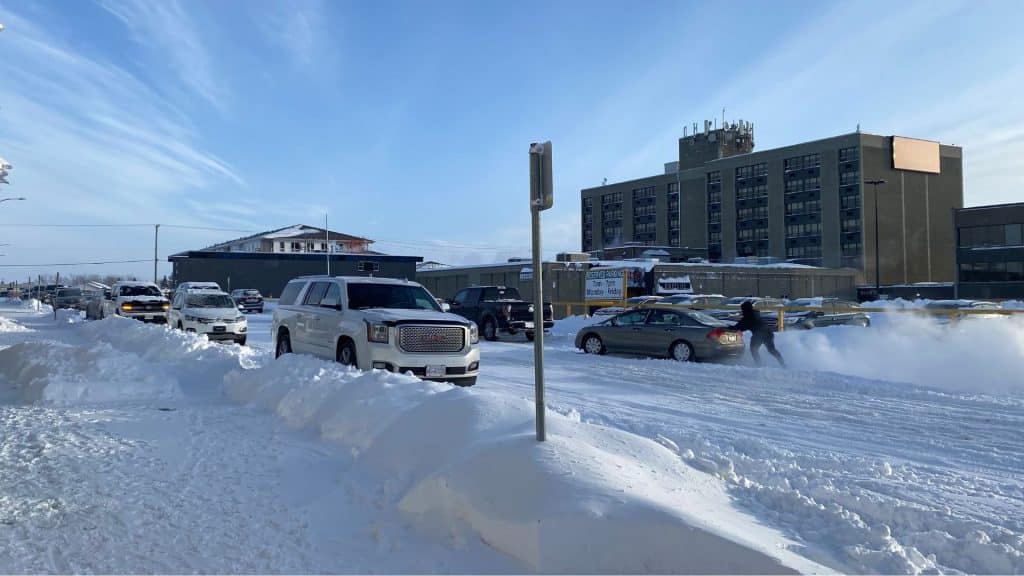
FORT ST. JOHN, B.C.— Fort St. John saw more than 200 centimetres of snowfall during the winter season 2025 – 2026.
According to the Daily Data Report by the Government of Canada, the Fort St. John area recorded 275.7 centimetres of snowfall during the winter season for 2025-2026.
In December of 2025, the city of Fort St. John recorded 103.9 centimetres of snowfall. This was the most snowfall in December recorded in the city since 2013, when 135.6 centimetres fell.
Brian Proctor, an Environment Canada meteorologist, in a previous statement to Energeticcity.ca, explained the weather was due to an “Arctic air mass” passing over the region.
In January 2026, more than half of the average snowfall occurred, with 17.5 centimetres falling in the first four days of the month.
The previously recorded snowiest January was in 2025 with 63.2 centimetres, or 60.6 millimetres of precipitation.
Bobby Sekhon, a meteorologist with Environment and Climate Change Canada, told Energeticcity.ca the winter in Fort St. John was cold and wet but not “too extraordinary.”
Latest Stories
“Our mean temperature for the winter, defined as December, January and February, was a minus 12.9 C compared to the normal of minus 11.1 [C],” he noted. “It was definitely below normal, but not ranking top 10 coldest [winters].”
In terms of precipitation, the city recorded 102 millimetres, compared to the normal of 74, Sekhon said.
He added the coldest day on record was December 20th, when temperatures fell to minus 36.3 C.
To keep up with the December 2025 snowfall, the city had to adjust its snow removal methods and bring in extra contractors.
As part of its category-based snow-clearing system, the city starts with high-traffic routes and emergency access roads before moving into residential areas.
Ryan Harvey, the city’s communication manager, previously told Energeticcity.ca contractors are assisting with road deemed category four, frontage roads and downtown paved lanes, and category five, which is residential and commercial streets.
In addition, the City of Fort St. John overspent its snow-clearing budget by almost $500,000 due to heavy snowfall in the region.
During a staff presentation before the council on February 6th, 2026, the report detailed the city overspent its 2025 snowfall budget by $484,000. The 2025 budget was $2.46 million, and the city spent $2.95 million.
According to the report, contracted services for road clearing equipment totalled “well over” the
budget.
In a recent statement to Energeticcity.ca, Harvey said: “If we look back at past years, certainly last winter, we received a lot more snow than we have in previous years.”
“That posed some challenges for the crews, just with the amount of snow and the timing of it, in December before Christmas, and then the warming temperatures in January always cause some havoc.”
Harvey added crews put out a “valiant effort” to try and keep up with snow removal.
The most challenging part of the winter season, Harvey said, was the amount of snow the city received in December.
“I think the fact we received so much snow in December in such a short amount of time and the cold temperatures certainly make life a bit more challenging,” Harvey noted. “I think ultimately the crews were able to do with it what they could. Then we’ll continue to move forward and look at how we can [better help] them [with] the process and policy [sides] of things.”
Sekhon noted, although “too much” cannot be said about the upcoming winter season at this point, Environment and Climate Change Canada will be monitoring an El Niño will develop later this year.
According to Environment and Natural Resources Canada, an El Niño is a phenomenon in which surface waters in the eastern tropical Pacific extend westward from Ecuador and become warmer than average.
This causes a shift in the atmospheric circulation and impacts weather patterns.
“Generally, the association in B.C. with El Niño is lower snowpack and usually milder temperatures,” Sekhon said. “[It] would be one factor to consider in terms of maybe a lower snowpack…in the winter, but again, it’s just one of many considerations, and we’re still quite a far way out to say with any confidence, but it’ll be something that we watch for.”
Sekhon noted one notable aspect of winter 2025-2026 was the prolonged period of cold.
He said: “Between December 8th [and] the 27th of December, it was quite cold, only one got warmer than minus 20 [C].”
Sekhon believes this happened to a really cold air mass which sat over the region, and no other weather pattern could move it out of place.
The city will review what worked and what did not, and make changes based on those findings.
Harvey said: “The public can expect some form of input opportunities, public engagement [opportunities] this summer, as we gear up for next winter, which unfortunately is depressing to already think about, given that the snow [has] just melted and summer is just here, but we’re always planning for next year.”
Stay connected with local news
Make us your
home page
Authors

Related Articles
Hudson’s Hope ER closes again for another week
The Hudson’s Hope Health Centre’s emergency department will be closed for another week until May 25th at 8.30 a.m.
Ford issues recall for select models due to windshield wiper manufacturing issue
Ford has issued a recall due to manufacturing issues with windshield wipers in select models from 2021 to 2023.

NEBC Chill hands out postseason memorial awards
the NEBC Chill gave out awards honouring former players Trace Morrell and Carter Kosick.