
AltaGas hopes to grow propane foothold in Chinese market
AltaGas says it’s been able to seize a meaningful foothold in the Chinese propane market and it sees more opportunity ahead.
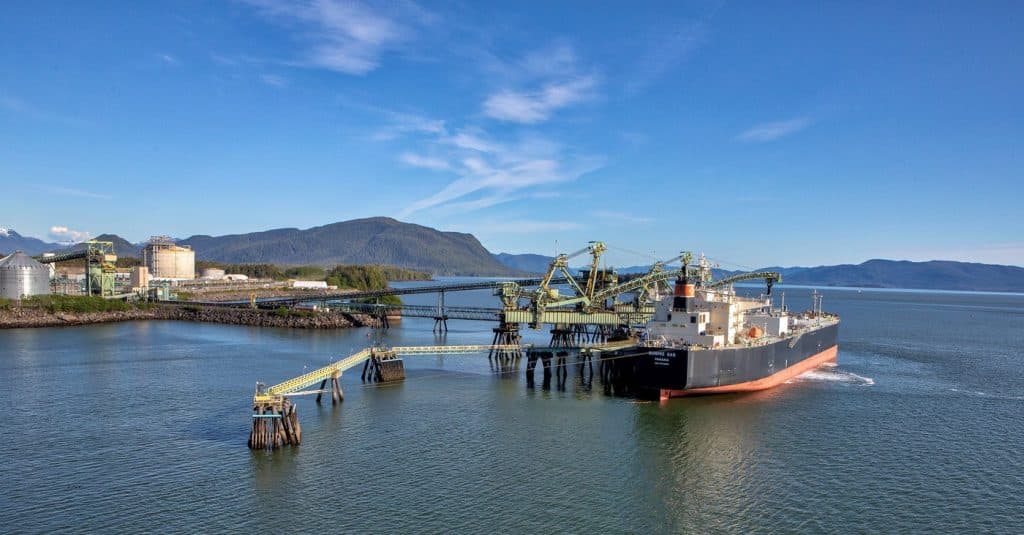
CALGARY, ALTA — Canadian energy infrastructure company AltaGas says it’s been able to seize a meaningful foothold in the Chinese propane market in less than a year and it sees more opportunity ahead.
AltaGas opened Canada’s first propane export terminal in Prince Rupert in 2019, but virtually all cargoes went to Japan and South Korea until April of last year, when it was able to tap into the Chinese market.
The Calgary-based company has rapidly grown its market share in China since then, now supplying six per cent of China’s propane imports.
It also makes up 14 per cent of South Korea’s and 11 per cent of Japan’s liquefied petroleum gas imports.
Demand has been flat in those two markets, but AltaGas has been able to grow its position thanks to the shorter shipping distance from B.C. than the U.S. Gulf Coast, said Randy Toone, executive vice-president at AltaGas and president of its midstream division.
“When you look at the growth in China, it’s been largely residential, as in more people are moving out of poverty and they’re using propane to heat their homes and cook. They’ve been using other products like wood and coal,” Toone said in an interview.
“But also, as China is modernizing, they’ve been building a lot of petrochemical facilities … So we want to penetrate that market further and that’s where a lot of the demand growth is coming from.”
Ottawa has been looking to double non-U.S. exports as U.S. President Donald Trump’s administration upends global trade and geopolitics.
Prime Minister Mark Carney said in Beijing on Thursday that Canada and China are entering a “new era of relations” that his government hopes will become an “example to the world of co-operation amidst a time globally of division and disorder.”
AltaGas expects propane and butane imports into Asia to grow 40 to 50 per cent by 2040.
Propane and butane can be categorized as either natural gas liquids or liquefied petroleum gases. The molecules can be separated out of natural gas at processing plants or can be a byproduct of oil refining.
NGLs and LPGs are not to be confused with liquefied natural gas, or LNG. That involves chilling methane to temperatures around -160 C so it can be shipped by sea in liquid form on specialized tankers. Canada’s first LNG export terminal, LNG Canada, started up last summer in Kitimat, B.C., and several other projects are in the hopper.
By contrast, propane only needs to be cooled to -40 C to be liquefied and for butane it’s -18 C, said Toone. That makes those export facilities much less expensive and complicated.
At the Ridley Island Propane Export Terminal south of Prince Rupert, AltaGas can store 1.2 million tonnes of propane a year and is licensed to export up to 92,000 barrels a day. The propane is shipped by rail to the terminal, where it is cooled and loaded onto ships. Netherlands-based Vopak owns 30 per cent of that project.
Construction is underway on an adjacent project called the Ridley Island Energy Export Facility, or REEF, a 50-50 joint-venture between AltaGas and Vopak. REEF aims to export both propane and butane initially, adding other products in the future. Toone said it’s slated to begin operations in early 2027.
Last year, AltaGas announced a deal to supply butane from REEF to Swiss-based BASF Intertrade’s petrochemical operations in China.
Approvals and permits are in hand for two planned optimization projects at REEF, so AltaGas is not planning to make use of the new federal major projects office in the near term. The office was set up last year to speed along projects deemed by Ottawa to be in the national interest.
Longer term, AltaGas is planning an expansion at REEF to allow for exports of products beyond propane and butane, like methanol.
“We potentially might use the major projects office for that but right now we’re not ready,” said Toone.
“We do support what they’re doing, but we don’t have any kind of projects teed up.”
AltaGas is also looking at First Nations equity agreements, but Toone said it’s “early days for those.”
Separately, the Alberta government has announced $14 million in funding to kick-start early regulatory work on a new oilsands pipeline to the northwest B.C. coast, possibly Prince Rupert.
The province aims to have an application ready for the major projects office mid-year, and has tapped a committee of industry players to work out a potential route.
A memorandum of understanding signed late last year between Ottawa and Alberta includes support for the pipeline alongside emissions-reducing measures. Both governments have said they want the private sector to take the lead and for there to be Indigenous ownership.
This report by The Canadian Press was first published on January 15th, 2026.
Companies in this story: (TSX:ALA)
Lauren Krugel, The Canadian Press
Stay connected with local news
Make us your
home page
Authors

Related Articles
Site C employment continues gradual decline in November
The number of workers employed on the Site C hydroelectric dam project saw an overall decline from October to November 2025.
Alberta launches website for potential new West Coast oil pipeline
The Alberta government has launched a website for the pipeline it wants to see built through B.C. to the coast.

Eby pitches ‘pivot’ from oil pipeline to refinery talks after Maduro capture
British Columbia premier David Eby says he would support building a new oil refinery in Canada over talk of a new pipeline across B.C. in the aftermath of the American capture of Venezuelan president Nicolás Maduro.