Indigenous explainers: What are handgames?
Handgames are a traditional Indigenous guessing game played between teams at cultural gatherings all across northeastern B.C.
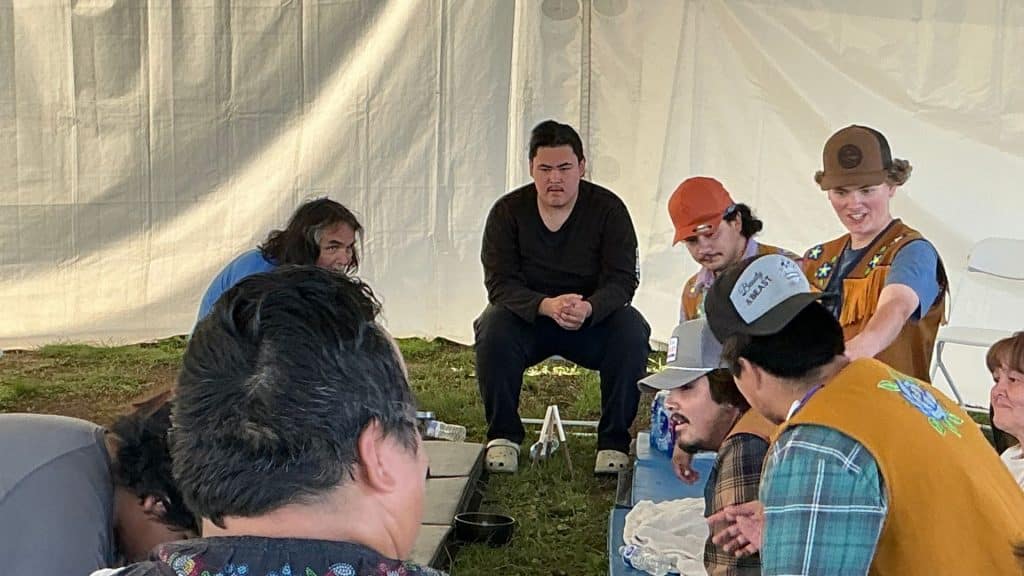
PROPHET RIVER FIRST NATION, B.C. — During Prophet River First Nation’s (PRFN) annual Treaty Days, a familiar drum beat echoes throughout.
Huddled in a corner, an enthusiastic crowd claps along to the sounds with participants laughing, cheering and enjoying a historical, traditional Indigenous game.
Handgames are a staple at Indigenous cultural festivals, and can best be described as part artistic performance, part guessing game.
Curtis Dickie has had a hand in promoting modern versions of handgames. A member of Fort Nelson First Nation (FNFN), he serves as PRFN’s cultural director.
At PRFN’s Treaty Days, $50,000 in prize money was available to be won. Dickie has also been involved with other handgames events, including tournaments at both Saulteau First Nations (SFN) Pemmican Days and Blueberry River First Nations (BRFN) Cultural Camp this year.
He’s also been involved with organizing the B.C. championships. The event was held in Fort Nelson in 2019 and 2021 and will return in 2026 with teams from Alberta, the Northwest Territories and the Yukon.
While taking a break, Dickie speaks about the importance of handgames to the Indigenous community.
Latest Stories
“Originally, the game would have been more of a form of entertainment [or] gambling,” said Dickie. “They did play for matches or bullets or horses. Historically, any object they could, they would be playing for.
“There’s another spiritual aspect of it. When Dene-zaa men used to go hunt and trap on the land, they would be taking a piece of that animal’s spirit when they killed it. Our people used to look at animals as equals. They would take the pain and have to absorb it. During the summer time, in gathering places like this, they would play and test whose medicine, or natural ability, was stronger.”
To play handgames, each team needs six members. Two teams, with one team designated to hide the object and one to guess.
Designated a shooter, the player must guess correctly who from the opponent’s team is holding an object and in which hand. If correct, they get a point, designated by a tree stick. If not, the shooter is out and the team not guessing gets a point.
Teams switch positions until there is a winner.
Games, such as the tournament at Treaty Days, are up to 15 points and a match is the best out of three games.
Accompanied by each team is a group of drummers, who play during the game. Dickie said the drummers are there to represent the heartbeat of Mother Earth.
Hand signals by the team not guessing are key in an effort to confuse the shooter.
“[Players] use all kinds of hand movements and gestures,” said Dickie. “Personalities really come out on the mat, especially these young men. You really see the pride involved when they play the game.”
The objects used during PRFN’s tournament are glass beads, similar to the ones used for Indigenous beading.
“The beat they use [is to] support each team,” said Dickie. “As the team goes longer, they drum faster and louder, until their team is out.”
There are other similar games, such as slahal, played by Indigenous people in the Lower Mainland, Vancouver Island and the Pacific Northwest of Washington State.
For the northeast B.C. bands, handgames provide a space for mental health support and mentorship for men. But like any other sport, it can get competitive.
“I’ve seen 93-year-old men play handgames,” said Dickie. “My three-year-old son plays handgames. The age range is very wide, but that drum and mentorship for men is now what the game has really grown to be.
“[There are] lots of men in native communities that are just struggling. So handgames, even if it’s just for the weekend, [is to] keep them healthy and with us.”
Stay connected with local news
Make us your
home page
Authors
Related Articles
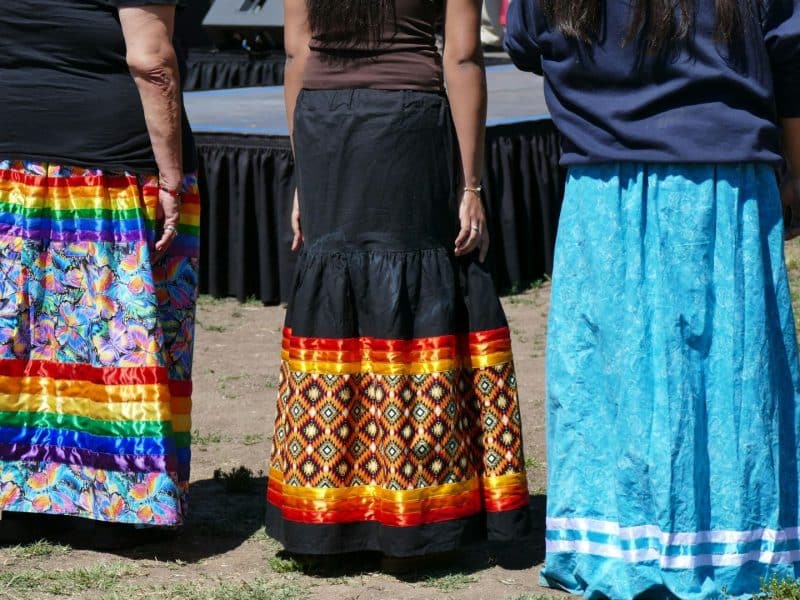
Indigenous explainer: What are ribbon skirts and why are they important?
Ribbon skirts seen as a symbol of womanhood in First Nations culture throughout history.
Fort Nelson community forest uses salvageable lumber funds for replanting
The Fort Nelson First Nation and Northern Rockies Regional Municipality gave an update on the sales of salvageable wood in its community forest.
Fort Nelson First Nation seeks directors for forestry company
Dechita – which translates to forest or bush – is the forestry arm of Fort Nelson First Nation.