
Lawsuit regarding Prince Rupert Gas Transmission pipeline dismissed
A petition challenging part of the construction ofthe PRGT pipeline has been dismissed by a B.C. Supreme Court justice.
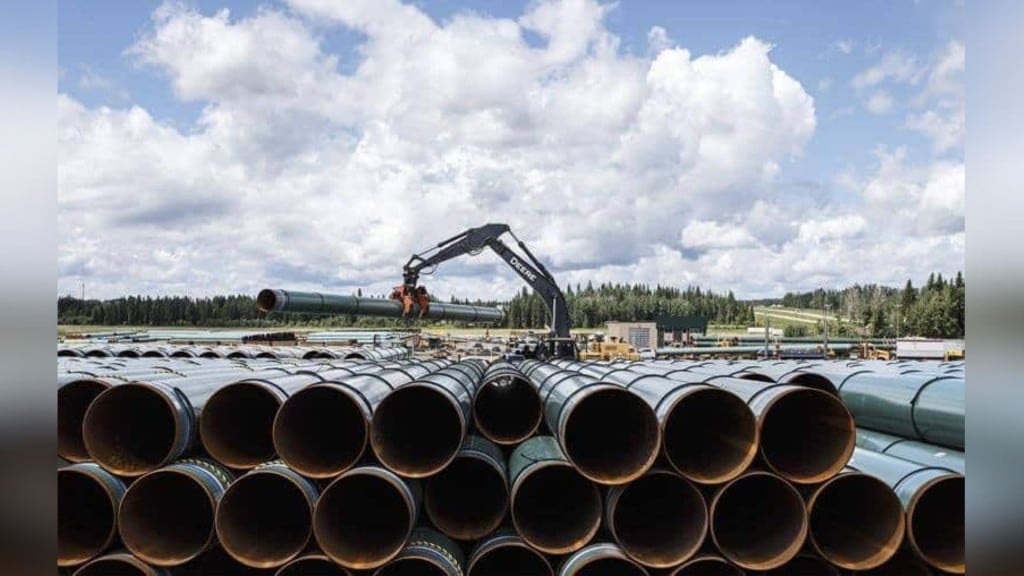
HUDSON’S HOPE, B.C. — A petition challenging part of the construction of a major gas pipeline has been dismissed by a B.C. Supreme Court justice.
In March, a small group of Indigenous and non-Indigenous groups partnered to accuse the BC Energy Regulator (BCER) in court of bending its rules to approve the construction of the Prince Rupert Gas Transmission (PRGT) pipeline.
The project is a 890-kilometre pipeline running from Hudson’s Hope, B.C. to an area 82 kilometres north of Prince Rupert. It was started by TC Energy in 2014, and in 2024 it was sold to the Nisga’a Nation and Western LNG.
The three groups — the Skeena Watershed Conservation Coalition (SWCC), the Kispiox Valley Community Centre Association (KCCA), and the Kispiox Band council — alleged in their petition that the BCER unlawfully allowed construction to start on section 5B of the pipeline.
Specifically, they claimed the BCER failed to ensure a “cumulative effects assessment” was done, which they said was a requirement of a deadline extension granted for that portion of the project.
In their response to the petition, the BCER, those responsible for the PRGT project and members of the Nisga’a Nation — whose land is being used for the project — argued the petitioners didn’t have standing to bring forward the lawsuit.
In a judgment dated August 20th, Supreme Court Justice Michael Tammen dismissed the petition, agreeing with the respondents that the petitioners didn’t have standing.
Latest Stories
“Kispiox Band initially sought private interest standing,” Tammen said in his judgment. “However, in the amended petition, this claim was abandoned. In the amended petition, all three petitioners seek public interest standing.”
According to Tammen, the decision regarding whether to grant public interest standing is made by the court, and comes down to three factors: whether there’s a ‘serious justiceable issue’ that’s been raised, whether the party seeking standing has a legitimate stake in the issue and whether the proposed suit is a reasonable way to bring that issue before the courts.
Regarding the first factor, he said the question raised by the petition must be “one of public importance which transcends the interests of those directly affected.”
In this instance, he feels there is no such issue, since “the petitioners challenge a decision to issue a permit to a single section of a pipeline project, which itself has already undergone a full environmental assessment and overarching review.”
“The thrust of the petitioners’ position is that, because of the passage of time, an updated cumulative effects assessment was necessary,” Tammen said.
“That submission hinges on the fact that the EAC (environmental assessment certificate) was in the final year of its ten-year lifespan. That is undoubtedly so, but the more important fact is that the EAC had not yet expired and was still valid.”
He also stated he felt the issue wasn’t of wide-ranging public importance, due in part to the specificity of the petitioners’ complaint.
“The petitioners accept, as they must, that BCER has the discretion to impose and change permit conditions when amending permits. Those powers are conferred by sections 25 and 26 of the ERAA (Energy Resource Activities Act).
“Here, the petitioners challenge only the interpretation of one such condition in a specific case. That is not a serious issue regarding, for example, the limits of administrative or executive authority, or broad-ranging questions of statutory interpretation.”
Regarding the second factor, Tammen agreed with the respondents that, since section 5B of the pipeline is located entirely outside of the Skeena watershed, and does not pass through the Skeena or Kispiox valleys, the three petitioning groups don’t have a serious stake in the issue.
Meanwhile, in terms of whether the proposed suit is a reasonable way to bring the issue before the courts, he said he feels it would be better to bring a similar petition forward when, or if, permission is granted to start construction on section 5A of the pipeline, which does cross through the Kispiox Valley.
“Considered cumulatively, the three factors do not favour granting standing to the petitioners,” Tammen said.
“To some extent, Skeena and Kispiox CCA appear to be ‘busybody’ litigants, seeking to challenge a micro-decision made in the course of a much larger project when that decision does not meaningfully affect them.”
However, he said he did view the Kispiox Band council slightly differently, refraining from calling them ‘busybody’ litigants but arguing their interests don’t precisely line up with the broader Gitxsan Nation community.
“There will be an opportunity for all three petitioners to make their opposition to the project known, when permitting decisions that directly impact their interests are made,” he said. “There is no compelling reason to grant them standing at this juncture when the decision at issue only relates to construction on Nisga’a lands.”
The petitioners have 30 days from August 20th to file an appeal.
Stay connected with local news
Make us your
home page
Authors

Related Articles
Prophet River First Nation chief named vice-chair of alliance supporting sustainable energy projects
Prophet River First Nation Chief Valerie Askoty was named vice-chair of the First Nations Natural Gas Alliance during the week of the BC Natural Resources Forum 2026 in Prince George.
Energy regulator approves Taylor to Gordondale pipeline project
The Canada Energy Regulator has approved Pembina Pipeline’s Taylor to Gordondale pipeline project for pre-construction preparations.
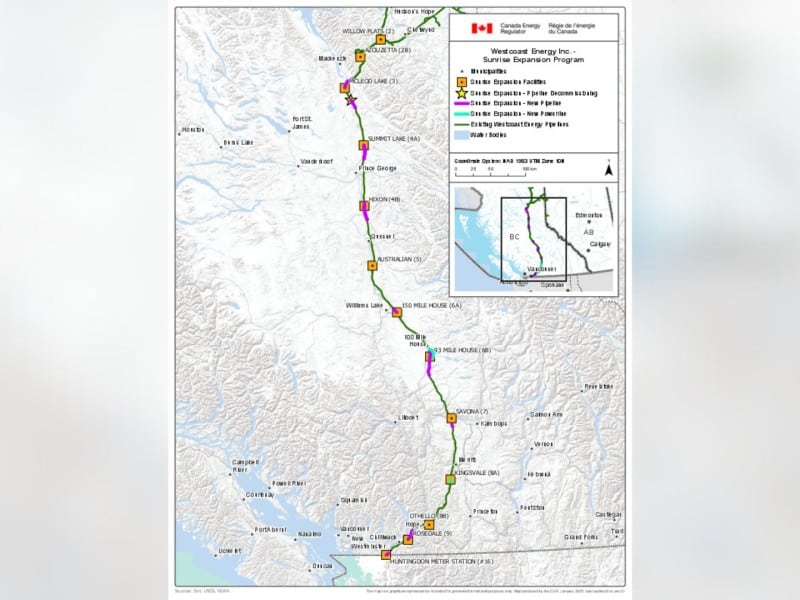
CER recommends approval of Westcoast’s pipeline expansion project
The Canada Energy Regulator (CER) found Westcoast Energy’s Sunrise Expansion Program to be in the public interest.