
Treaty 8 First Nations, province sign land, resource agreement
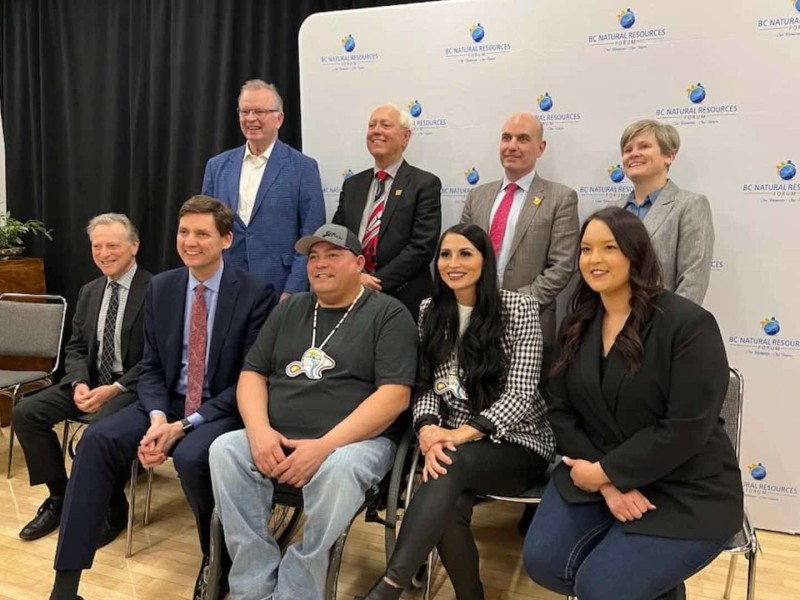
PEACE RIVER, B.C — Four Treaty 8 First Nations signed an agreement with the Province of B.C. this week focusing on the planning and management of land and resources.
The First Nations involved —Fort Nelson, Saulteau, Halfway River and Doig River First Nations — created a set of initiatives titled the Consensus Document with the province following Blueberry River’s cumulative impacts win in 2021.
The province said it continues to negotiate with the remaining Treaty 8 Nations in B.C., including West Moberly First Nation, Prophet River First Nation, and the McLeod Lake Indian Band.
According to the province, the Consensus Document “builds a path” to ensure that Treaty rights are protected, the land is restored, and resource development and economic activity are supported.
The initiatives outlined in the document include a new approach to wildlife co-management, new land-use plans and protection measures, cumulative effects management system, a multi-year restoration fund, and a new revenue-sharing approach to support the nations.
Pilot projects will also be revealed to advance shared decision-making for planning and stewardship activities and a collaborative approach to promoting education about Treaty 8.
Latest Stories
Doig River Chief Trevor Makadahay said the Nation has been advocating for a meaningful role in resource development occurring in its territory for years, adding that the band looks forward to working with the province in the coming months to make it a reality.
“We are confident that through this important work, which includes developing a new fiscal relationship between Treaty 8 First Nations and the Province, we will create economic certainty, heal the land and our people, and create overall stability for the region for generations to come,” Makadahay said.
The Consensus Document includes measures to address industrial disturbances in Treaty 8 territory which the province said has fragmented ecosystems, wildlife habitat and reduced access to native plants necessary for cultural practices, significantly impacting treaty rights.
The provincial government will establish a Treaty 8 Restoration Fund, which will have shared oversight and reporting, as well as an Indigenous-led delivery.
Contributions, including the $200 million fund promised to the Blueberry River First Nation – B.C. fund earlier this week will see Treaty 8 nations receive over $600 million over the next 10 years.
Both the province and the nations will seek contributions from industry, non-government organizations and the federal government.
In a presentation, the province said that land restoration expenditure is incremental to already existing obligations.
The province said that land use planning in the 1990s didn’t do a good enough job of recognizing and protecting Treaty 8 rights, nor did it reflect the interests of Treaty 8 nations or involve them in a meaningful way.
Saulteau First Nation Chief Justin Napolean echoed the province’s statement, stating that the band’s treaty rights had been neglected and discounted by industrial development and poorly planned land use decisions.
“Our treaty lands and our communities have been fragmented by the cumulative impacts of [these] decisions. This new agreement shows that this government intends to work with us to find new ways for co-management and true partnership. We believe that we can protect environmental and cultural values, and support communities through better planning for long-term and sustainable economic activity,” Napolean said.
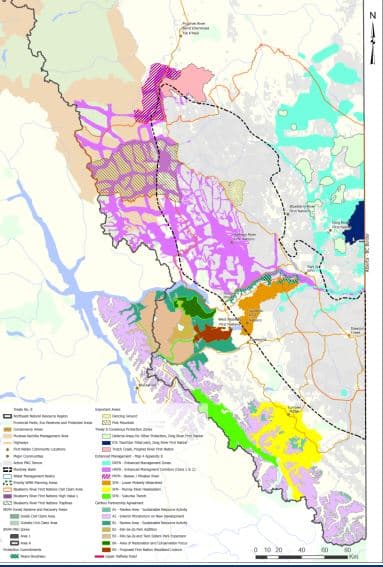
A new component of land planning in the Consensus Document is the creation of new protected areas, which the province said could include interim measures to reduce or pause new authorizations in those areas.
Other measures include the establishment of “enhanced” management zones to better recognize Treaty 8 rights and the generation of new regional land use plans, which the province said incorporates existing treaty rights and conservation commitments.
The province said that it will continue to provide updates and seek input from industry, local governments and residents of Northeast B.C.
The first map below — supplied by the province — highlights new protection proposals, while the second shows the enhanced land management areas.


The provincial government also provided a second set of maps to highlight the current protected areas and sites that will come under protection.
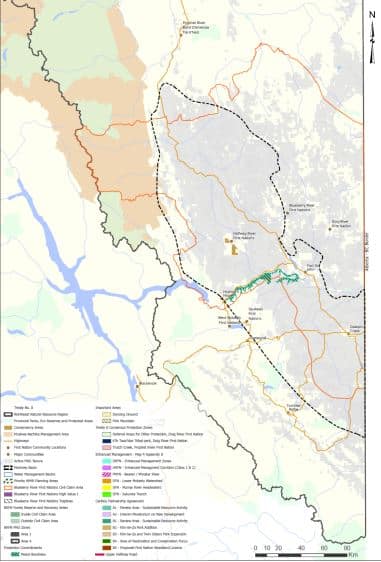
Wildlife management was also a key topic in negotiations. The Consensus Document includes a promise by the province to work collaboratively with the nations on wildlife co-management, which will start with improving shared knowledge on wildlife populations by combining Indigenous knowledge and western science.
The provincial government said it will adjust previous interim hunting restrictions as it gathers new knowledge.
The province said that there will be a “substantial focus” on moose and caribou management, which includes hunting regulations, in an effort to assist in the meaningful practice of treaty rights.
It will also create a regional wildlife working group to unite Treaty 8 nations and relevant interest groups.
Other measures include an increase in the monitoring of key wildlife populations, the development of a plan to eliminate the use of aerial herbicides in the area and an increased compliance and enforcement presence on the land aimed at ensuring regulatory and program changes are understood and respected.
The provincial government said it will continue its support for caribou recovery and associated predator management, adding that it will stand behind cultural burning and the development of burning plans to promote wildlife habitats.
Earlier this week, the province and Blueberry River First Nation (BRFN) announced that they’d reached an agreement after over a year of private negotiations. The BRFN agreement includes a $200 million dollar land restoration fund and an annual 750-hectare limit on new disturbances from oil and gas activities in the BRFN claim area.
Read the province’s most recent release below.
Stay connected with local news
Make us your
home page
Authors

Related Articles
Emergency department at Chetwynd becomes second in region to close Christmas Day
The emergency department at Chetwynd General Hospital is the second in northeast B.C. to close December 25th, 2025.
Power outage affects more than 1,110 in Fort St. John and surrounding areas
A BC Hydro power outage affected 1,119 BC Hydro customers in the Cecil Lake, Fort St. John and Doig River First Nation areas on December 17th.
Summit Lake wildfire evacuation order expanded
The Summit Lake wildfire evacuation order has been expanded.