
(UPDATE) FOI revealed LNG’s use of Spare Flare due to ongoing defect in flare stack
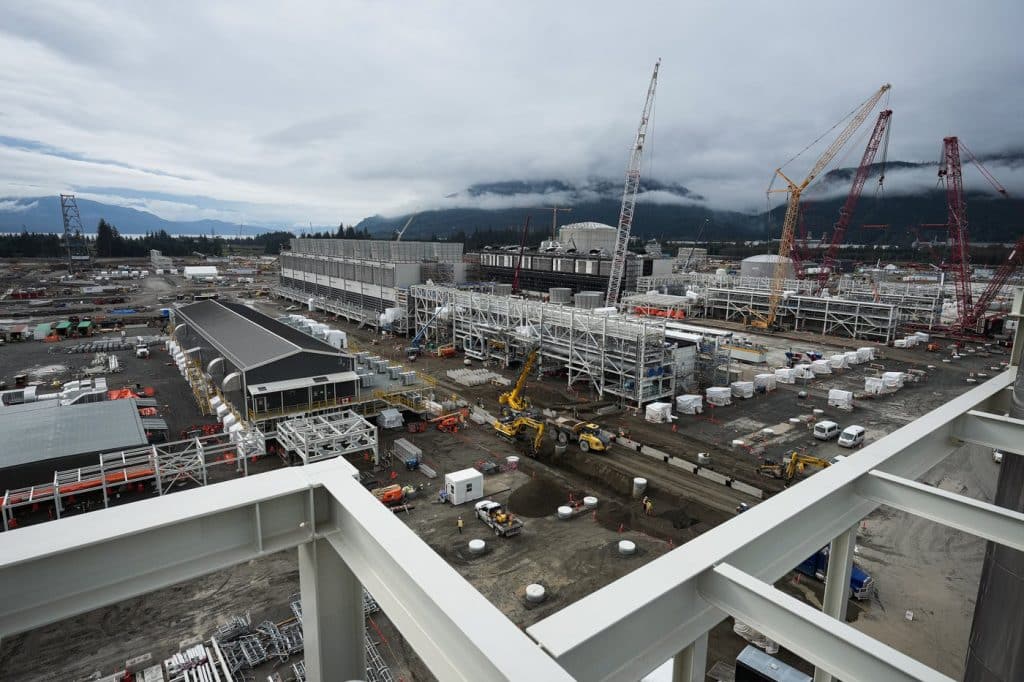
An ongoing operational defect has cracked LNG’s flare stack in Kitimat, leading to the use of the facility’s spare flare as its largest source of flaring in March.
Updated: May 14th, 9:45 a.m.: This article was updated to include a statement issued to Energeticcity.ca by LNG Canada.
FORT ST. JOHN, B.C. — LNG Canada has been using its emergency spare flare as its largest source of flaring in March.
According to a release by My Sea to Sky dated May 12th, freedom of information (FOI) requests revealed that an ongoing operation defect with LNG Canada’s flare stack in Kitimat has cracked the facility’s flare tip.
This comes after the Kitimat facility was issued an order by the British Columbia Energy Regulator on April 22nd, following an inspection that revealed at least two instances of non-compliance with the company’s permit, which limits black smoke emissions.
Spare flares are used during “emergency” or “upset” scenarios, meaning these emissions are not regulated by permits.
The release said that according to the company and its permit, LNG Canada is “is currently in the regular ‘operations’ phase,” the release said.
Even though the company’s largest flaring by volume happened during the emergency spare flare, the facility’s cold/dry and storage/loading flares exceeded the permitted volumes in March:
Latest Stories
- The facility’s cold/dry flare is at an average monthly rate of 29.7 cubic metres per minute against the permit limit of 9.6 cubic metres per minute.
- The storage/loading flare’s monthly average rate was 40.3 cubic metres per minute, against the permit’s limit of 6.0 cubic metres per minute.
In a written statement to Energeticcity.ca, an LNG Canada spokesperson said LNG Canada is in the early stages of operations, a complex phase for any LNG facility as systems are tuned to operate “safely and reliably under real-world conditions.”
“Flaring is a normal and necessary part of stabilizing the facility during this phase and is expected to decrease as operations become steady,” the spokesperson said.
“During this phase, LNG Canada has experienced flaring volumes higher than anticipated under its Air Waste Discharge Authorization.”
LNG Canada stated it’s main focus remains of safe and stable operations as it works within B.C.’s regulatory framework and progresses towards steady-state operations.
The spokesperson said: “Ambient air quality monitoring in Kitimat continues to show air quality in the good, or low-risk, range based on the Air Quality Health Index reported by the Kitimat Airshed Group.”
“Independent third-party monitoring, reporting and verification also indicate that community air quality remains within applicable B.C. Ambient Air Quality Objectives.”
The spokesperson said LNG Canada will continue to monitor, report and work closely with regulators, First Nations and local communities as it safely brings the facility into stable, long-term operations.
Tim Doty, former technical air expert at the Texas Commission on Environmental Quality (TCEQ), current Technical Advisor to the Texas-based nonprofit Oilfield Witness, and president of TCHD Consulting, said he has spent three days in Kitimat conducting an optical gas imaging (OGI) field assessment of LNG Canada.
“During this monitoring project, I documented significant and sometimes massive uncombusted and partially combusted emissions being released from multiple exhaust stacks and a damaged and malfunctioning flare that was not being operated as designed and represented,” Doty said.
He added that the emissions filled the airshed with pollution “over and beyond” the company’s property line.
“[The pollution] would be expected to negatively impact the adjacent community and downwind receptors, pending meteorological conditions,” he added. “I have personally performed OGI assessments at most of the operational LNG plants in both Texas and Louisiana over the last several years, and I can honestly say that I was shocked by what I documented at LNG Canada.”
My Sea To Sky’s executive director, Tracey Saxby, believes the industry is operating unsafely in Canada.
My Sea to Sky is an environmental organization founded in 2014 to defend, protect and restore Átl’ḵa7tsem / Howe Sound.
“Governments are allowing that to happen at the expense of human health. This is an emerging public health crisis,” she said.
“[The federal government] needs to step in and issue a stop‑work order to LNG Canada, which has been spewing unregulated toxic chemicals into residential areas and exceeding its flaring permits by up to 40 times.”
She added that the issues have persisted for close to a year.
“If this is the precedent oil and gas majors are setting for LNG in Canada, imagine what will happen with smaller, less experienced companies like Western LNG’s Ksi Lisims project or Woodfibre LNG,” Saxby said.
According to a news article by The Globe and Mail on April 9th, the facility flared an average of 40 times more gas than its permit allows, both warm/wet and cold/dry flares, during the last three months of 2025 and the first month of 2026.
Stay connected with local news
Make us your
home page
Authors

Related Articles

Memorandum of Understanding reached regarding floating LNG project
the agreement is a non-binding strategic partnership aimed at collaboration regarding a in-development liquified natural gas project