
Drivers advised to regularly wash vehicles to prevent rust as salt brine use resumed on North Peace highways
Dawson Road Maintenance started applying salt brine on highways in the North Peace region in November.
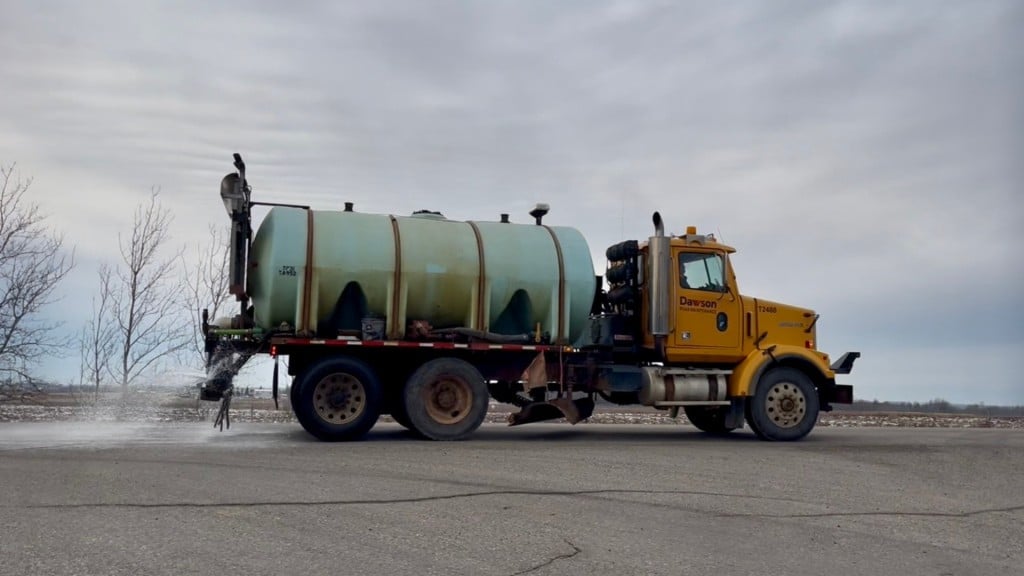
FORT ST. JOHN, B.C. — Dawson Road Maintenance has once again started applying salt brine on highways in the North Peace region.
In a Facebook post on November 12th, the highway maintenance contractor shared that its brine truck was treating North Taylor Hill, Mile 54 hill and “some hot spots along Highway 29.”
Dawson Road Maintenance, which holds the provincial contract to maintain highways across much of northern B.C., said the use of brine is a “strategic move” aimed at keeping ice from forming before it becomes a hazard.
Local News Straight
to Your Phone
Download our app today!
Available on Android and iOS devices
According to the Ministry of Transportation and Transit’s TranBC website, brine is a key tool used by maintenance contractors for both anti-icing and de-icing during winter months.
“Ice is not nice under vehicle wheels,” the ministry noted. “Our maintenance contractors use brine for anti-icing and de-icing, to help keep highways safe in winter.”
Brine is made by blending salt (sodium chloride) with water, typically about 77 per cent water and 23 per cent salt.
The mixture lowers the freezing point of water, which the ministry says prevents ice from forming on the pavement and helps to melt existing ice or compact snow. The freezing point of salt brine is typically around -20°C.
Latest Stories
According to the ministry, brine is sometimes mixed with other chlorides, such as calcium or magnesium chloride, to improve performance in lower temperatures.
While solid rock salt is still used in some cases, the ministry says brine can work faster and stays on the road more effectively in dry conditions.
“Salt brine is more effective at lower temperatures than rock salt, and it stays on the road in dry conditions,” the ministry said. “Whereas rock salt can bounce off or be blown off hard surfaces like ice or pavement.”
However, the ministry said it remains useful when temperatures are warmer and when the road surface is rough enough for the salt grains to settle.
However, some concerns about brine have been raised.
In a 2017 CBC report, Freeman Young, president of Krown Rust Control, warned that liquid brines, particularly the calcium chloride solution, can accelerate rust far more aggressively than traditional road salt.
“It will be spread nice and evenly… waiting to catch snow and ice and melt it from the underside up,” Young said. “But the challenge with it is, it will also be waiting to come up under your car or your truck. The effects of these liquid materials on vehicles is fairly dramatic.”
Young told the CBC that Ontario drivers have faced increased corrosion on wiring, electronics and critical undercarriage components since brine became common on roads.
“There are advantages, but… when you look at the damage to bridges or any fixtures that are actually attached to roads and to actual cars and trucks themselves, it’s a huge disadvantage,” he told CBC.
Both Young and the Ministry of Transportation and Transit recommended regularly washing vehicles during the winter months to remove any brine residue.
Stay connected with local news
Make us your
home page
Authors

Related Articles

Long-standing Spirit of the Peace Pow Wow president resigns
Connie Greyeyes has resigned from her position as board president of the Spirit of the Peace Pow Wow.
Site C work camp moved to support nation-building project in northern B.C.
VANCOUVER — BC Hydro says it’s relocating and repurposing the majority of its work camp for building the Site C hydroelectric dam to support the construction of the North Coast…

Joint federal-provincial commission into Tumbler Ridge shooting an option: minister
VICTORIA — A joint federal-provincial commission could look into the shooting that killed eight people in Tumbler Ridge, B.C., says British Columbia’s public safety minister. Nina Krieger says a joint…