
B.C. court hears Chinese police went ‘missing’ for hours during trip to Vancouver
VANCOUVER — British Columbia’s Supreme Court heard Tuesday that three Chinese police officials went “missing” for six hours during an RCMP-escorted visit to Vancouver in 2018, setting off concerns they could be trying to illicitly repatriate someone. The revelation came during testimony by RCMP Supt. Peter Tsui at the trial
VANCOUVER — British Columbia’s Supreme Court heard Tuesday that three Chinese police officials went “missing” for six hours during an RCMP-escorted visit to Vancouver in 2018, setting off concerns they could be trying to illicitly repatriate someone.
The revelation came during testimony by RCMP Supt. Peter Tsui at the trial of William Majcher, a former RCMP officer who has pleaded not guilty to a security offence in relation to his alleged work for the Chinese government.
Tsui said he had helped facilitate the visit by the delegation from the Chinese Ministry of Public Security during his time as a liaison officer stationed in Beijing.
He said it involved 22 Chinese officials split between Toronto and Vancouver and was “hosted” by Canadian police to work on “mutual files” related to market fraud, money laundering and “economic fugitives” over about nine days.
But Tsui said three of about 14 officers visiting Vancouver failed to show up to a meeting and instead went missing, with RCMP having “no idea” where they went.
“As we transitioned from Toronto to Vancouver to start our second series of meetings for the files that were in (B.C.), one of the investigative teams was not at our allocated or designated meeting times for presentations,” Tsui said.
He told the court that “safeguards” were put in place “at the borders and at the airports because there (were) certain individuals in Vancouver that we were concerned about being returned to (China).”
It had taken significant negotiation to arrange the trip and the incident affected “police-to-police trust” between authorities in the two countries, he said, adding the RCMP had repeatedly told Chinese police they could not operate in Canada.
Tsui said the incident happened after the relationship had already “started to take a turn” in 2017, when the Canadian government denied China’s request to station two Chinese liaison officers in Vancouver, on top of two already based in Ottawa.
Asked why the request was denied, Tsui said Canadian authorities wanted consistency.
“Any police-to-police co-operation would be through the embassy. So, they had their two (liaison officers) assigned in Ottawa, we had two (liaison officers) assigned in Beijing, and at the end of the day, any co-operation for police-to-police, basically, issues, was through those two offices and not a satellite office.”
Tsui said the decision elicited a negative reaction by Chinese authorities.
“It was a direct rebuke from one of their director generals to the RCMP and basically a statement that it would hurt the policing-to-policing relationships.”
Tsui said the second development that caused a “really significant impact” to the relationship was the December 2018 arrest of Huawei executive Meng Wanzhou at the behest of United States authorities attempting to extradite her on fraud charges later resolved with a deferred prosecution agreement, allowing her return to China.
His testimony came on the second day of Majcher’s trial in Vancouver. The former Mountie pleaded not guilty Monday to one count of committing “preparatory acts” for an offence under Canada’s Security of Information Act.
The prosecution alleges Majcher had prepared to coerce B.C. resident Hongwei Sun, also known as Kevin Sun, into returning to China, where he was wanted for financial crimes, for the benefit or at the direction of the Chinese government.
The trial follows a B.C. Supreme Court ruling last month in which Justice Martha Devlin found Majcher’s warrantless arrest at Vancouver’s airport in 2023 was unconstitutional, occurring without reasonable and probable grounds.
Devlin found the grounds for Majcher’s arrest “amount only to a hunch or generalized suspicion” that he engaged in a conspiracy to assist China’s efforts in a manner that would contravene Canadian law, the March 26 ruling said.
The ruling described a police report that said Sun was wanted in China for financial crimes “ranging into the hundreds of millions of dollars.”
It said the report indicated Sun, a Vancouver resident, “allegedly used the proceeds of his financial crimes to purchase large amounts of real estate” in the city.
Tsui testified Monday that he first heard about Sun in 2016, when Chinese authorities alerted him to a “historical fraud” case dating back to the late 1990s or early 2000s in which an individual had allegedly defrauded the Industrial Commercial Bank of China of 2.8 billion yuan, now worth about $560 million.
Chinese authorities believed about $120 million had left China, alleging Sun had taken it, and indicating he was living in the Vancouver area, Tsui said.
Chinese authorities had initially asked the RCMP to arrest Sun, but Tsui said they did not provide sufficient information for Mounties to make a determination.
Tsui said Chinese authorities then asked if they could speak to Sun, prompting a request to Mounties in Vancouver to find him, but he refused to attend a meeting.
The RCMP then advised Chinese authorities that the Mounties were halting work on the file in February or March 2017, officially closing it a year later, Tsui said.
This report by The Canadian Press was first published April 21, 2026.
Brenna Owen, The Canadian Press
Stay connected with local news
Make us your
home page
Authors

Related Articles
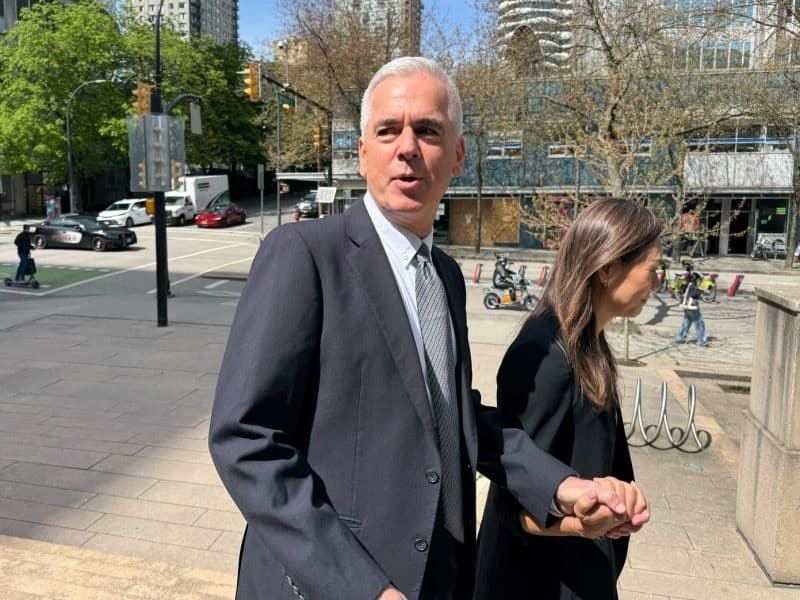
Ex-Mountie, accused of helping China, pleads not guilty to security offence
VANCOUVER — The trial of a former RCMP officer got underway in British Columbia Supreme Court Monday, with prosecutors alleging William Majcher prepared to coerce a resident of the province to return to China, where he was wanted for financial crimes. Majcher stood as he pleaded not guilty to one
Slain Mountie’s family decries ‘systemic failure’ after suspect ruled unfit for trial
VANCOUVER — The family of British Columbia RCMP Const. Shaelyn Yang says they’ve lost trust in the institutions she served after the suspect in her killing was deemed unfit for trial, while denouncing “systemic failure” they say puts front-line workers at risk. A victim-impact statement from the family says a

B.C. guide gets $30,000 penalty for leading client on hunt outside licence area
MCBRIDE — A British Columbia hunting guide has been ordered to pay more than $30,000 in penalties after admitting to taking a client outside of his designated hunt area. The B.C. Conservation Officer Service says in a social media post that the offence took place in September 2022 near McBride,