
Oil giant broke deal to deactivate thousands of pipelines and faced no penalty, documents reveal
Canadian Natural Resources Ltd. (CNRL) failed to meet targets it proposed to the BC Energy Regulator (BCER) to gradually deactivate more than 4,300 pipelines.
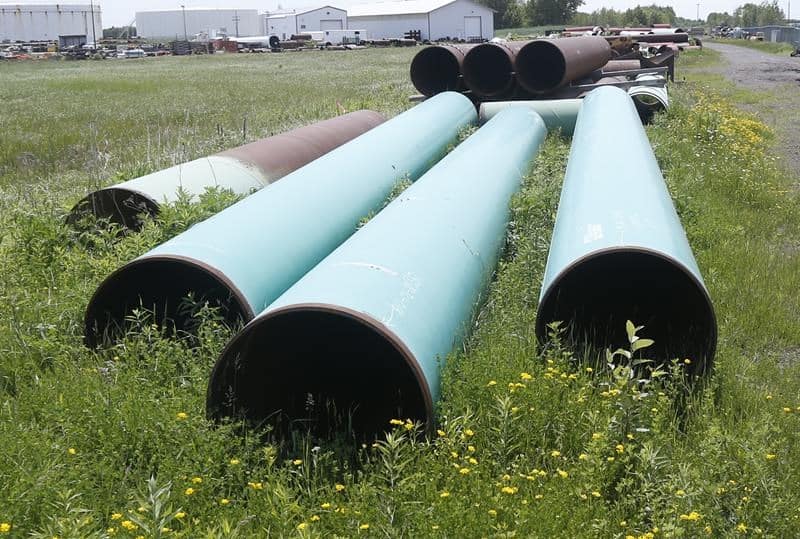
NORTHEAST B.C. — One of Canada’s largest oil and gas companies violated a deal it struck with B.C.’s energy regulator to address thousands of inactive pipelines in the province — and faced no financial penalties for doing so.
Internal government documents obtained by The Narwhal and the Investigative Journalism Foundation reveal Canadian Natural Resources Ltd. (CNRL) failed to meet targets it proposed to the BC Energy Regulator (BCER) to gradually deactivate more than 4,300 pipelines it operated across the province.
It is unclear why the company failed to meet the requirements for deactivating its pipelines, including failing to follow its own plan. The company did not respond to multiple requests for comment made via email and over the phone.
Companies like CNRL operate thousands of short pipelines which connect natural gas wells — including fracking operations — to major pipeline networks. When the wells no longer produce gas, companies operating in B.C. are required to decommission pipelines within 18 months.
This legal timeline is aimed at protecting the environment from leaks and damage as pipelines gradually decay. Deactivating a pipeline includes removing any fluid and disconnecting it from the system. The sealed-off pipeline remains in the ground in perpetuity.
In 2020, the BCER found CNRL hadn’t deactivated thousands of pipelines and set out to get the company back into compliance with the law. CNRL proposed a detailed, multi-year plan for decommissioning its pipelines as part of an exemption from B.C.’s normal environmental regulations.
Under that plan, CNRL was to deactivate a targeted number of pipelines each year until 2028, with exact annual targets ranging from 398 to 544. BCER agreed and gave CNRL an extra eight years to get the work done.
But in 2023, the regulator revoked CNRL’s exemption after learning the company “failed to deactivate the pipelines in accordance with the timelines set out in the plan,” according to documents obtained under freedom of information (FOI) legislation. The regulator later said in a statement that CNRL had failed to meet targets for three years in a row.
Latest Stories
That led to the regulator issuing an order demanding CNRL clean up some of its pipelines and CNRL complied.
BCER then approved a second exemption for CNRL in 2024 and says the company is exceeding targets under that plan.
The regulator told The Narwhal and the Investigative Journalism Foundation in an emailed statement it did not fine CNRL (which posted gross revenues of more than $41 billion last year, according to its 2024 financial statements) because it did not deem it necessary.
The regulator added it could still “pursue a contravention and the issuance of an administrative monetary penalty in the event CNRL does not meet its remaining deactivation requirements.”
In early March, CNRL still had 865 pipelines to decommission, according to a previous statement from the regulator.
In March 2024, BCER vice-president Nicole Koosmann wrote to CNRL expressing concern the company “failed to complete the deactivation requirements under the initial plan” but said complying with the normal rules was “not reasonably practicable” given the thousands of pipelines that had to be shut down.
“I am further satisfied that adherence to the targets and commitments set out in the updated plan remains the most effective and efficient way to achieve compliance with regulatory requirements and to minimize the risk associated with the remaining pipelines,” she wrote at the time.
Koosmann’s letter to CNRL came after government officials discovered the company had “not met the targets for any of the years 2020, 2021 or 2022,” according to an unattributed statement from the regulator.
That led the regulator to invoke a clause in the agreement that rendered it null and void if the company failed to meet its end of the bargain.
The regulator then issued a general order, forcing the company to deactivate hundreds of pipelines, and renewed the pipeline exemption. The spokesperson said it struck the second deal with CNRL in part because of the “public interest in having the pipelines brought into compliance more quickly with less land disturbance.”
Martin Olszynski, the chair in energy, resources and sustainability at the University of Calgary’s law school, said CNRL has a track record of being slow to clean up and deactivate its assets.
As of June 2nd, the Alberta Energy Regulator reported CNRL holds more than 20,000 inactive wells in that province — or more than 25 per cent of Alberta’s inactive wells.
“It’s consistent with a pattern that I’ve seen that this is a company that has a really hard time dealing with the backends of its assets,” Olszynski said.
CNRL is now “exceeding their targets for pipeline deactivation” under the new plan, which would see the company shut down all of the pipelines by 2028, according to the regulator.
Olszynski said the BCER’s approach — ordering the company to comply but stopping short of a fine — could be perceived as soft. But he also pointed out it seemed to produce the desired effect of jolting the company into compliance.
“The regulator has been pushing and pulling. It has used the power that it has to force these guys to do the work,” he said.
The regulator also has a vested interest in maintaining a good relationship with the company, he added.
“As a regulator, they’re not about bringing down the man,” Olszynski said. “Capitalism, that’s beyond their wheelhouse.”
BCER, formerly the BC Oil and Gas Commission, is mostly funded by levies on companies that run oil and gas projects. The sector has been expanding in recent years as B.C. gears up to become a major exporter of liquefied natural gas (LNG).
The B.C. government has been allocating extra powers to the BCER, including responsibility for overseeing renewable energy projects such as wind farms.
This investigation is a collaboration between The Narwhal and the Investigative Journalism Foundation.
Stay connected with local news
Make us your
home page
Related Articles
Expansion project delaying shipping and receiving of core from Fort St. John
The core facility in Fort St. John will be unable to ship or receive core due to a warehouse expansion, BCER said.
Parties agree to final investment collaboration on LNG Canada phase two
LNG Canada Phase two will double the terminal’s capacity to 28 million tones of liquified natural gas annually.
Organizations call on federal and B.C. governments to mandate health impact assessment of LNG Canada’s Phase One
More than 50 organizations are asking the federal and B.C. government to conduct an independent assessment of LNG Canada Phase 1.