
Bear Flat Dispatch: Trade axe found
Frequent contributor Ken Boon found a little piece of history last December while hiking in the Bear Flat area.
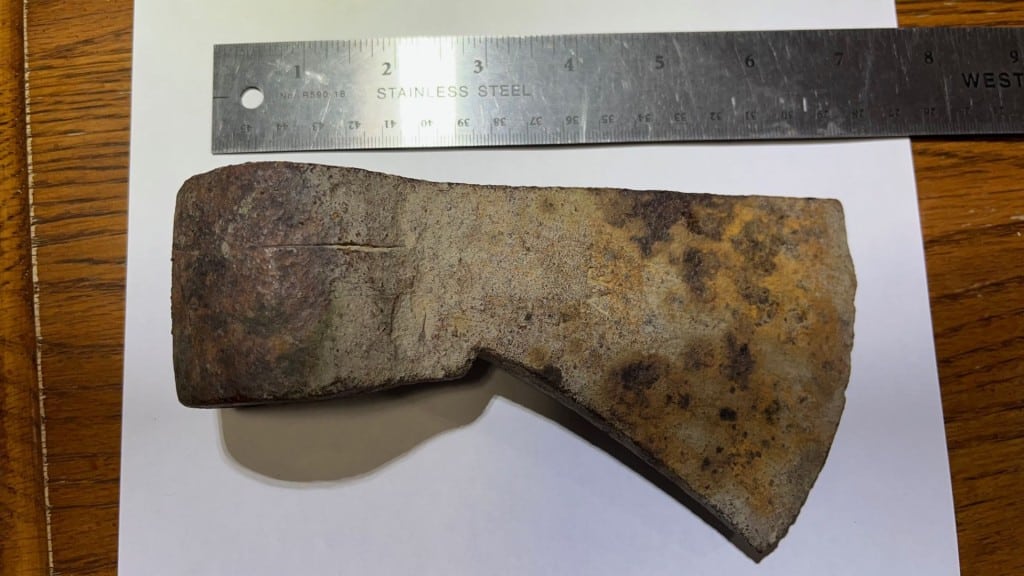
FORT ST. JOHN, B.C. — I was hiking east of our home last December on our hillside quarter section when I noticed a bit of rusty steel sticking out of the ground. Due to the unusually bare and very dry ground conditions, I was able to dig up what turned out to be a rather unusual old axe head in really good condition.
In researching my find, I came across Mark Miller from Ohio, who is very knowledgeable on the topic and runs an excellent website. In correspondence with him, he confirmed that this was indeed what is known as a trade axe and was likely made in the first half of the 19th century.
This axe would have travelled across Canada by canoe with the fur brigade primarily for trade with the local First Nations. Axe heads were shipped without handles, which were then made locally by traders or Indigenous customers.
It was common practice for blacksmiths to stamp their name or initials on axe heads, and this one is marked with “AF.” Mark has a good database matching initials to specific blacksmiths, but he is not certain of this one. However, he did note that there was an Alexander Fraser working as a blacksmith at Fort William in Ontario from 1813 to 1819 for the Northwest Company, so that is a possibility.
As always, when an old artifact is found in an unusual location, one can’t help but wonder just how, when, and why this axe ended up on a grassy southwest-facing hillside overlooking the Peace River. If only the axe could tell its story. However, there is an excerpt from the book “Prophesy of the Swan” that perhaps gives a clue:
On May 16th, 1793, at a spot believed to be either Jim Rose Prairie or Bear Flats, Alexander Mackenzie wrote the following passage as he was proceeding westward to the Pacific Ocean:
“Mr. Mackay, and one of the young men, killed two elks, and mortally wounded a buffalo, but we only took a part of the flesh of the former. The land above the spot where we encamped, spreads into an extensive plain, and stretches on to a very high ridge, which, in some parts, presents a face of rock, but is principally covered with verdure, and varied with the poplar and white birch tree. The country is so crowded with animals as to have the appearance, in some places, of a stall-yard, from the state of the ground, and the quantity of dung which is scattered over it. The soil is black and light. We saw this day two grisly and hideous bears.”
Latest Stories
As I am writing this morning, I can look out the window to the hillside where I found the axe and see a few elk grazing there right now. That got me thinking about what could have happened back then.
Mackay and the young guy had the axe with them while butchering the elk when they got a little rattled from the appearance of the “two grisly and hideous bears,” so they accidentally left the axe behind when they headed back down to camp. They probably realized their error later, but by then, the grizzlies were seen eating what was left of the elk, and no one was thrilled about going back up there just for an axe.
Who said history is boring? You may think that is a little far-fetched, but prove me wrong…..LOL!
The axe head is in such good shape that one could put on a new handle, sharpen it, and put it back to work. However, after a couple hundred years, it probably deserves better than that.
As the Fort St. John North Peace Museum already has three fur trade-era axe heads on display, we will exhibit this one in our little museum here at Bear Flat. Please feel free to stop by this summer when we are selling corn or some other produce and check it out.
Stay connected with local news
Make us your
home page
Letters to the Editor
Letters to the Editor should be exclusive to Energeticcity.ca. Include your name, address and daytime phone number. Keep letters to 500 words or fewer. Letters may be edited for length and clarity. To submit a letter by e-mail to contact@energeticcity.ca.
Related Articles
(Opinion) Bear Flat Dispatch: Looking back to 2016 and the difference a decade makes
To celebrate the 2026 new year, regular contributor Ken Boon uses a column he wrote in 2016 to illustrate all the changes in the Peace River region over the last decade, such as the construction of the Site C dam.

(OPINION) Enserva CEO: So, you signed an MOU on energy – now what?
Gurpreet Lail, CEO of Enserva – the industry association for energy – writes on the recent memorandum of understanding signed between Ottawa and Alberta.

(Opinion) Bear Flat Dispatch: A ‘hostile takeover’ of municipal elections
In this column, regular contributor Ken Boon is adding his voice to those who oppose the registering of the Conservative Electors Association in Fort St. John and other municipalities around B.C.