
UPDATE: Northeast B.C. sees significant rise in syphilis cases
Northeast B.C. has seen a significant rise in syphilis cases, according to the BC Centre for Disease Control.
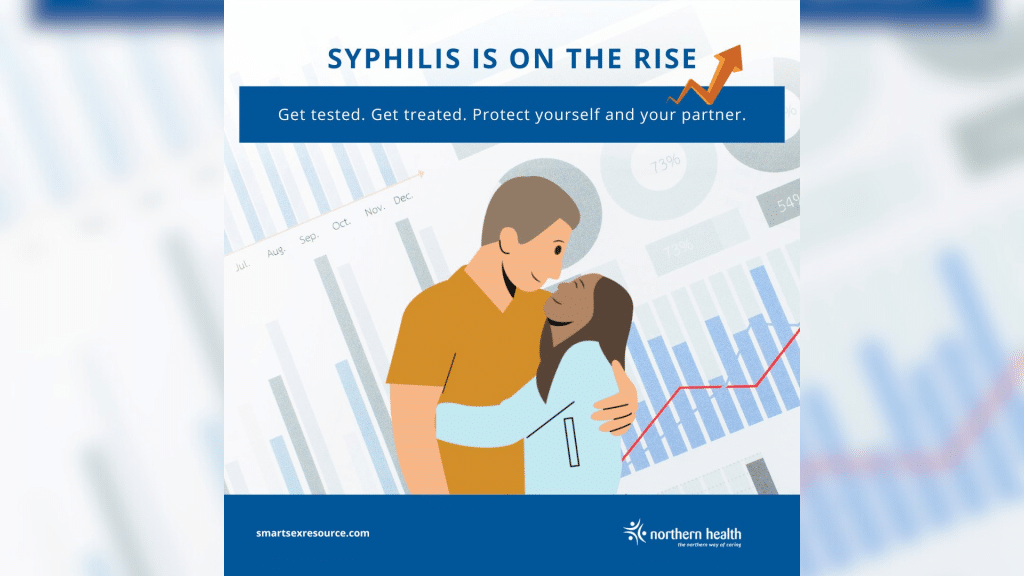
FORT ST. JOHN, B.C. — Northeast B.C. has seen a significant rise in syphilis cases, according to the BC Centre for Disease Control.
In 2022, Northeast B.C. saw a rate of just under 40 syphilis cases per 100,000 people, a considerable increase from 2.8 cases per 100,000 in 2018.
While Vancouver Coastal Health Authority reported the highest number of infectious syphilis cases, Northern Health Authority reported the highest rate of infectious syphilis, said the BC CDC’s 2023 third-quarter report.
Local News Straight
to Your Phone
Download our app today!
Available on Android and iOS devices
Doctor Rakel Kling, a medical health officer with Northern Health, says it’s vital for people to know syphilis is out there and is affecting people of all sexual orientations and ages equally.
In the northeast, however, she says syphilis is primarily affecting heterosexual men and women.
“It’s really important to get tested for syphilis,” Kling added.
“It should be included as part of regular sexually transmitted infection screening, but it’s just great to be aware of to make sure it’s part of the screen.”
Latest Stories
Kling says the increase in northern B.C. started around 2020 but saw its largest jump in cases last year.
In the Northern Health region, cases of syphilis in 2022 increased by five times the amount in 2021 — from 8.6 cases per 100,000 people in 2021 to 43.5 cases per 100,000 in 2022.
The doctor says she doesn’t think there’s a good theory as to why there’s been such a significant increase across the province.
“I think there’s maybe a bit of a lack of awareness that syphilis has been spreading throughout B.C. for quite a while now,” Kling said.
“It just hasn’t hit the north until about the last little while.”
Syphilis is a sexually transmitted infection (STI) that can be asymptomatic, meaning it does not show any symptoms at all.
“[This] is why it’s important to get regular testing based on your health care provider’s recommendations,” Kling said.
When syphilis does show symptoms, a common early indicator is a painless sore, which can develop anywhere from three to 90 days after sexual contact.
“It’s usually in the genital area, but it can happen in other places where there’s sexual contact, like the lips or mouth,” Kling said.
Other symptoms of the infection include a rash, headache, fever, hair loss and swollen lymph nodes.
“The longer you wait to get it treated, and as [syphilis] progresses into further and further stages, it could actually be latent or lie dormant, which is very problematic,” Kling said.
“This is where it might not be symptomatic at all anymore, which is why it’s important to get tested.”
She said the treatment might vary a little depending on the stage of syphilis, but it is treated with prescribed antibiotics.
Kling adds that all STIs are serious infections, and it is important to use condoms and get regular testing done.
STI testing is available on Tuesday afternoons by appointment only at the Fort St. John Health Unit at 10115 110th Avenue. The phone number is 250-263-6000.
More information on sexual health can be found on Smart Sex Resource, a service provided by the BC Centre for Disease Control.
Stay connected with local news
Make us your
home page
Related Articles

New pool to honour Fort St. John businessman in its name and with 20-foot statue
Fort St. John’s new pool is to be named after one of the city’s most recognizable residents, local businessman Trevor Bolin.

Vehicle’s hood destroyed in Highway 97 crash in Fort St. John
Emergency services were reportedly on the scene of a crash on the Alaska Highway in Fort St. John on March 31st.

Tumbler Ridge shooting victim Maya Gebala is out of intensive care: dad
VANCOUVER — The father of Tumbler Ridge, B.C., mass shooting victim Maya Gebala says his daughter has been transferred out of intensive care into a “recovery and rehab-focused unit.” David…