
PRRD to issue public apology to Treaty 8 members following Treaty Land Sharing meeting
PRRD board members voted in favour of issuing a public apology to Treaty 8 First Nations and all members of the public regarding Treaty Land Sharing.
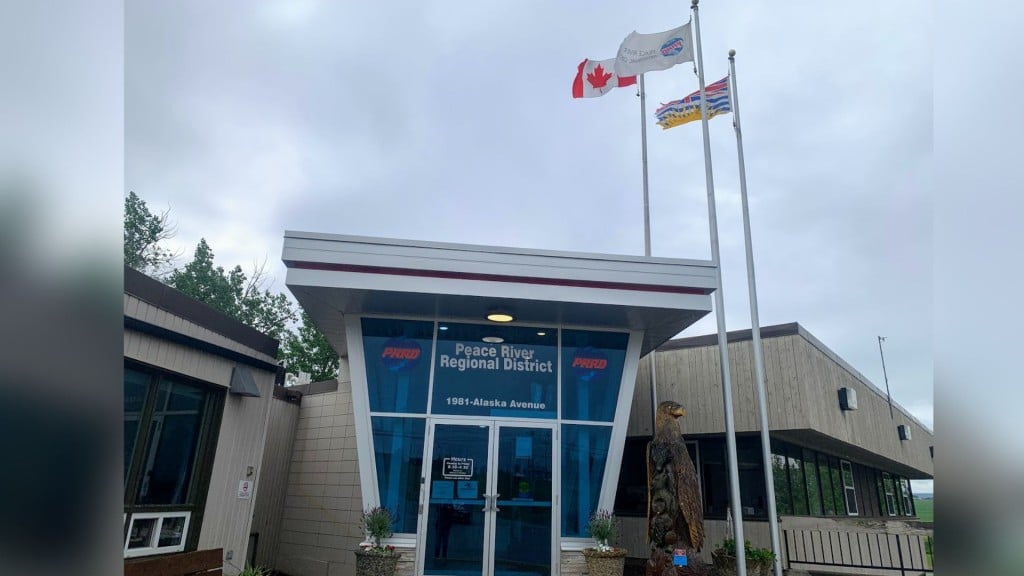
DAWSON CREEK, B.C. — Peace River Regional District (PRRD) board members voted in favour of issuing an apology to Treaty 8 First Nations and all members of the public following the June 8th committee of the whole meeting regarding a Treaty Land Sharing Network.
A recent letter addressed to the PRRD from Doig River, Halfway River, and West Moberly First Nations expressed concern and asked to seek accountability for the PRRD’s “failure to address highly inappropriate and anti-Indigenous remarks made during the meeting.”
Board members discussed the letter and voted in favour of issuing the apology during a regional board meeting on June 29th.
The June 8th committee of the whole meeting was held for the purpose of providing information to the public about the concept of Treaty Land Sharing Networks. Held at the Pomeroy Hotel and Conference Centre, the meeting was deferred due to over-capacity as a result of over 1,000 concerned residents and landowners in attendance.
The purpose of Treaty Land Sharing is to honour the intent of the original Treaties by sharing the land for mutual benefit while connecting farmers and ranchers with Indigenous people by providing safe and respectful access to their land. Treaty Land Sharing is a voluntary process with the sole intention of building relationships between local First Nations and landholders who choose to participate.
The letter from the four First Nations listed above said the meeting “quickly escalated into an environment filled with disrespect and hostility” and accused the PRRD of failing to “dispel the misinformation and anti-Indigenous, derogatory comments contrary to the PRRD’s policies and commitments made to moving forward in a reconciliatory manner.” The letter states the meeting should have been halted prior to being shut down and deferred.
During Thursday’s board meeting, Fort St. John mayor Lilia Hansen began the discussion by sharing her observations at the June 8th meeting.
Latest Stories
“What the signatories to this may not be aware of is that directors and PRRD staff were walking around the ballroom at the June 8th meeting, trying to dispel misinformation and answer questions because we value our relationship with our neighbours,” said Hansen.
“Please know that as a board, we did not sit back. We walked out into the crowd to answer questions in advance and explain what we knew.”
Hansen also stated she was “saddened” by the way the proposed voluntary program rolled out as a result of the spread of misinformation because it “hurt many relationships between elected officials, area residents, First Nations, family, and friends.”
Electoral Area B director Jordan Kealy spoke after Hansen, saying he thought the board handled the meeting to the best of their ability, considering the circumstances, and claimed he “didn’t hear any racist comments” despite watching the video of the meeting afterward.
“I don’t think we did anything wrong,” said Kealy.
“We conducted ourselves appropriately. As for the individual actions of certain people – we can’t control that.”
Mayor of Taylor, Brent Taillefer, responded to Kealy, saying the focus shouldn’t be on who is right or who is wrong.
“People were hurt, this letter identifies that, and I feel terrible that someone feels this way,” said Taillefer.
“I don’t think discussing whether people were right or wrong is even relevant when we need to heal.”
Taillefer continued by suggesting the board invite the First Nations who wrote the letter to meet in person with the board and “get to healing.”
“I don’t think talking about the letter here or just accepting it and not responding is appropriate. I don’t think responding with a letter is appropriate either. We need to reach out, sit in a circle and talk.”
Electoral Area E director Dan Rose shared his belief that a lesson should be learned based on what happened at the June 8th meeting and in reference to the spread of misinformation on social media.
“Maybe we need to become more nimble with reacting to what’s out there and understanding what’s building on social media,” said Rose.
Rose added that a lot of people attended the June 8th meeting to listen and didn’t get the opportunity because they were “drowned out by a few folks that weren’t there to listen.”
“Most of the people that were in that building are my generation and live on the land,” said Rose.
“They’re solid people that drive this whole region, so we shouldn’t paint them all with the same brush, and that’s one of the things I don’t care for in the letter.”
Regional board chair Leonard Heibert echoed Taillefer’s sentiments, agreeing that a letter in response wouldn’t be sufficient.
“I think we’re going to have to sit across the table and have a conversation,” said Heibert.
“Numerous times that we have dealt with First Nations, they have told us not to be scared to ask the tough questions, and I think that this is an opportunity to sit down and do that.”
Chetwynd mayor Allen Courtoreille shared his “perspective as an Indigenous person” and as a member of Treaty 8 and chose to forego the Special Committee of the Whole meeting on Wednesday, June 28th, which was held as a follow-up to the June 8th meeting.
“It was such a terrible thing that I witnessed in that room [during the June 8th meeting] that I didn’t go to the second one,” said Courtoreille.
“As a person sitting in that room, it was very difficult, and it’s still difficult today.”
Courtorielle described his experience at the June 8th meeting by saying he felt “uncomfortable” and “unsafe.” He continued by agreeing with Taillefer and Heibert that an in-person meeting with affected First Nations was necessary.
“We need to have people on our board that are elected from First Nations communities,” said Courtoreille.
“If they have that position, then we have a direct voice.”
Kealy responded to Courtoreille’s take on the June 8th meeting by saying the concept came forward “at a really bad time” while “tensions are high and people are stressed about money.”
“The turnout we saw in that room, those were tax-paying constituents that were there to express concerns,” said Kealy.
“Their concerns were to say, this is none of your business, if they want to share their land, they can just do it person to person.”
Kealy continued by apologizing to Courtoreille for the “way he felt at the meeting” and for its intensity, to which Courtoreille responded by saying, “Not accepted.”
Board members continued to go back and forth on the subject but ultimately came to the conclusion that a public apology was necessary, and furthermore, an in-person meeting with local First Nations to discuss how to move forward was crucial in taking steps towards reconciliation.
The regional board voted all in favour of “issuing a public apology to the Treaty 8 First Nations and all members of the public who were subjected to the distressing and offensive comments made during the June 8th Committee of the Whole, acknowledging the gravity of the situation.”
The board also voted in favour of inviting Doig River, Halfway River, Prophet River, and Moberly Lake First Nations to a future community-to-community forum format to discuss their concerns outlined in their letter.
The video from the June 19th regional board meeting can be viewed on the PRRD’s Facebook page.
Stay connected with local news
Make us your
home page
Authors

Related Articles
Victim of Charlie Lake ‘altercation’ identified by RCMP amid homicide investigation
The person who died on March 13th after an “altercation” at the Charlie Lake boat ramp has been named as Gurkirat Manocha.

Warning of more than 10cm of snowfall around Fort Nelson and Pine Pass
Environment Canada has issued two warnings because more than 10cm of snow is expected in Fort Nelson and through the Pine Pass on March 15th and 16th.
Fort St. John colon cancer survivor supports call to lower age requirement for screening
A Fort St. John woman who overcame colon cancer, Denise Christie, says she supports expanded early detection screening programs across the country amid Colorectal Cancer Awareness Month in March.